Buy Less Crap. Invest Simply.
Helping you spend less, save more, and live a simpler life — plus showing you exactly what I do with my own money. No fluff, no fake gurus, just honest talk and common sense.
Free forever. No credit card. Just honest investing talk from someone who's been doing it since 1999.
Compounding
The 8th Wonder
For educational purposes only. This content provides general information about spending habits, saving and personal finance. It is not financial advice or a recommendation to take any financial action. Always consider your own circumstances before making financial decisions. Capital at risk. The value of investments can go down as well as up and you may get back less than you invest. This is what I do — not financial advice.
New (Sort Of)
A Book, Apparently.
You didn't ask for this book. But here it is anyway.
Always good to have a book or two fire up the mind.
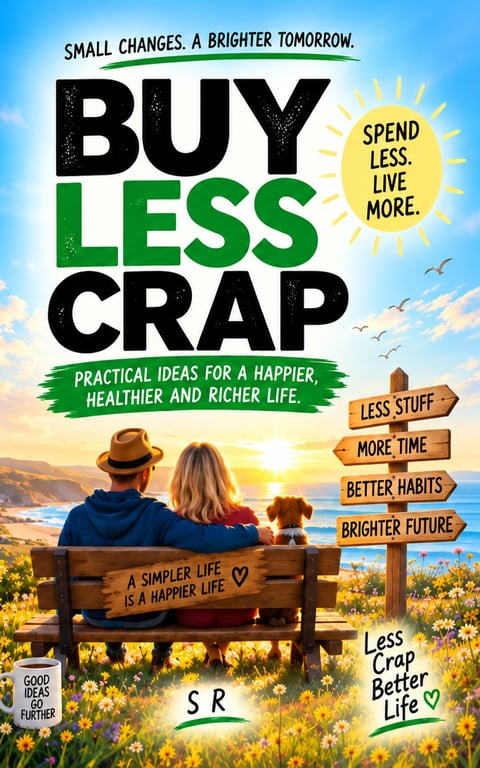
Buy Less Crap
Practical ideas for a happier, healthier and richer life.
Everything the site is about — but in a book. Less crap. More living. Same honest tone, same simple ideas, now in something you can leave on a shelf and pretend you've read.
Written by S R — the same person who runs this site, in case you were wondering.
→ → "📖 Kindle · 📕 Paperback · 📚 Hardback · 🎧 Audiobook — all in one place"
Buy Here If You Must →Turns Out There Are Nine
Nine Books. Same Nonsense.
A comedy series about a King who shouldn't be. A survival guide to modern life. And, somehow, a dystopian thriller. Real life, practical ideas, more laughs — a brighter tomorrow (probably).
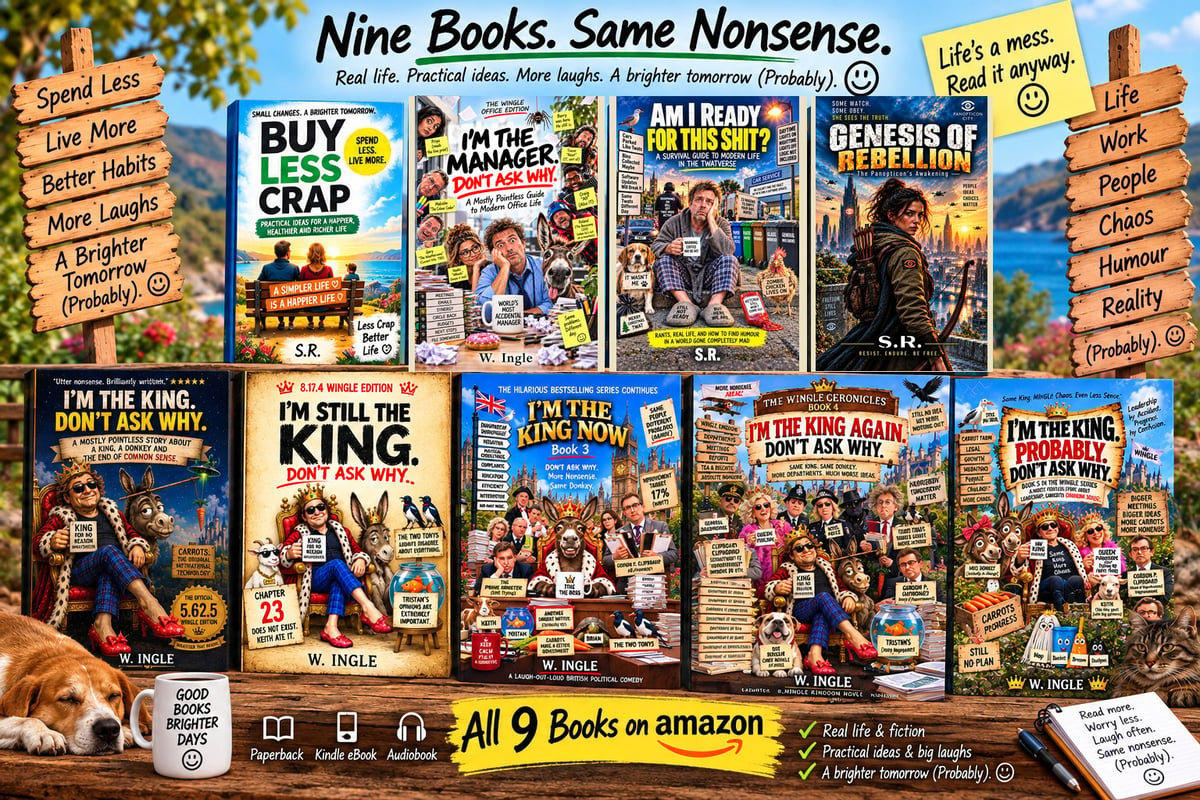
All 9 books on Amazon · Paperback · Hardback · Kindle eBook · Audiobook
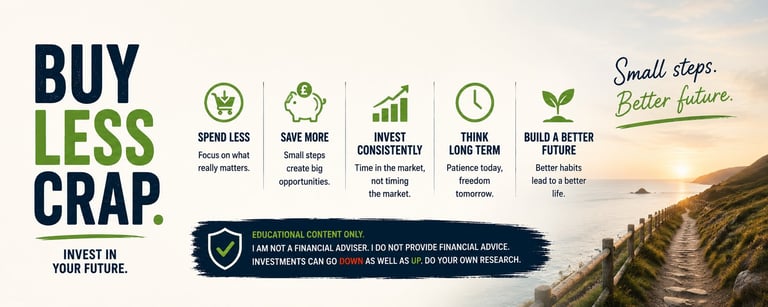
Small Steps. Better Future.
Spend Less
Cut the waste, keep the joy.
Save More
Watch your surplus grow.
Invest Consistently
Time in the market, not timing.
Live Simply
Less clutter, more freedom.
This site isn't just about investing — it's about spending less on things that don't matter, saving the difference, and building a calmer, simpler financial life. I share what I do with my own money along the way.
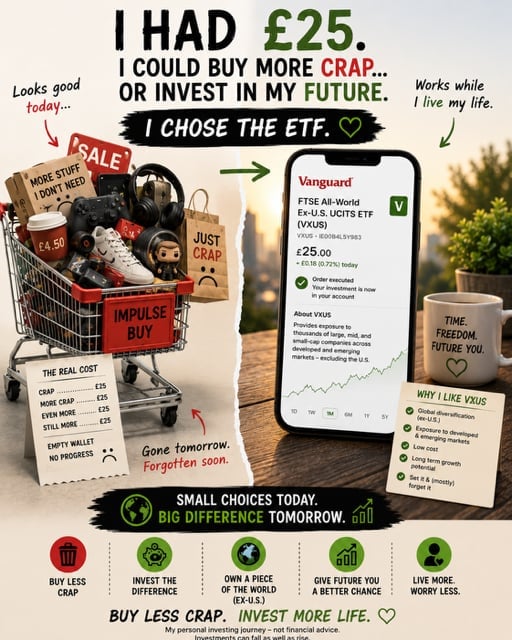
Good Old Common Sense
Making more than money sat in the bank. Or buying plain crap and coffees you can cut down on.
Something worth considering: high-street bank accounts often pay very little interest. Meanwhile, banks lend out deposits at much higher rates. Whether keeping cash in the bank, investing it, or spending it makes sense depends on your goals, timeline, and circumstances.
I personally choose to put spare cash into broad-market ETFs rather than leaving it in low-interest accounts. Markets have historically grown over very long periods, but future returns are uncertain, losses can occur, and past performance doesn't guarantee future results. This is what I do with my money — it may not be right for you.
Affiliate Disclosure
Everything on Buy Less Crap is free. I will receive a small commission referral fee from some platforms I mention — Trading 212, InvestEngine, and others pay a commission when you sign up through a link. That doesn't cost you anything extra. It's how I keep this site running without charging anyone a penny. Full transparency, always.
Buy less coffee. Buy less crap. Invest the difference. Give your money the chance to grow — but remember, all investing carries risk and values can go down.
The Real Foundation
Where Is Your Money Really Going?
Most people don't have an investing problem.
They have a spending problem.
Individually they don't look like much.
Together they can quietly cost hundreds or even thousands of pounds every year.
Buy Less Crap Isn't About Never Spending Money
I'm not here to tell you to stop living.
Life is for enjoying.
The goal is simply to become more aware of where your money goes and whether what you are buying is genuinely making your life better.
Before making a purchase, ask yourself:
Sometimes the answer will be yes.
Sometimes it won't.
The important thing is making a conscious choice.
The Buy Less Crap Challenge
For the next 30 days, I tracked everything I spent that wasn't essential.
You don't need to judge yourself.
Just track it.
Most people are surprised by what they discover.
Small Changes Can Make A Big Difference
Nobody becomes financially secure overnight.
Good habits are built one decision at a time.
A few better choices each week can help create more options, less stress and greater freedom in the future.
Whether your goal is a holiday, a house deposit, paying off debt, building savings or simply having more breathing space, it all starts with understanding where your money is going.
Start With Awareness
You don't need a complicated budget.
You don't need spreadsheets.
You don't need to become obsessed with money.
Just start paying attention.
Small choices today can create a very different tomorrow.
Buy Less Crap. Build Better Habits. Create More Freedom.
For educational purposes only. This website does not provide financial advice, investment recommendations or regulated financial services. Any references to saving, investing or personal finance are general information only. Always do your own research and seek professional advice where appropriate.
Important — Please Read
I'm not an investment guru.
I'm just an ordinary bloke trying to make my money work for me — instead of sitting in a bank account doing very little.
No fancy trading strategies.
No charts with a hundred indicators. No day-trading. No guessing. Just steady, boring investing.
No overnight promises.
Anyone promising overnight riches is either lying or selling something. A solid portfolio is built steadily over decades, not days.
No pretending I know the future.
I have no idea where the market is going tomorrow — and neither does anyone else. What I do know is that over 20+ years, it tends to go up.
What this site actually is
Personal experience
I share what I do with my own money — what I buy, what I hold, and why I made those choices.
Education & opinion
Everything here is what I've learned over 25+ years of investing. Take what's useful, ignore what isn't.
Transparency
I post my actual portfolio, real trade confirmations, and honest updates on what's working and what isn't.
Common sense
No secret formulas. No insider knowledge. Just the simple principles that have worked for generations of investors.
If you're looking for investment advice, I'm not your man.
If you're looking for an ordinary person trying to build a better financial future — sharing what I do, what I learn, what works, and what doesn't — you're in the right place.
I simply invest regularly into ETFs and quality companies, keep learning, and let time and compounding do the heavy lifting — across a Stocks ISA, a SIPP, and individual shares.
Read the Full StoryWhat You'll Find Here
Simple investing for normal people.
No complicated strategies. No insider jargon. Just the stuff that actually works for everyday investors taking a steady, long-term approach.
All investing carries risk. The value of investments can go down as well as up. This is what I do — not advice.
The Strategy
What I do. Not what you should do.
This is my personal approach. I share it so you can see one person's thinking — not as a template to copy. Broad-market ETFs, invested consistently, have historically been part of long-term strategies — though past patterns don't guarantee future results and you should make your own decisions.
I chose a platform
I opened an account on a platform that suited me — there are several good options, each with different features.
I picked a broad ETF
I went with a broad global or S&P 500 ETF — low fees, wide diversification. The choice is yours to research.
I automated it
I set up a monthly contribution. Same amount, same day, every month. Automation removes emotion from the equation — for me, that was key.
I got on with my life
I stopped checking the ticker. I let compounding do its thing in the background. That worked for me — though everyone's approach is different.
Remember: all investments can fall as well as rise. Past performance is no guarantee of future results.
Read The Full StrategyHow I Use Trading 212 Pies
This is what I do personally — not financial advice. All investing carries risk. The value of your investments can go down as well as up.
One of my favourite features on Trading 212 is the Pie — a simple way to group investments into percentages you decide, then automatically spread every deposit across them.
It's like designing your own mini-ETF. Pick a handful of ETFs, set the split, and Trading 212 handles the rest.
To illustrate the concept, a Pie might contain a mix of different ETF types — but what you include (if you use Pies at all) is entirely your decision:
This is an illustration of the Pie concept — not a suggested allocation. The percentages and ETF types are purely for explanation.
Every time you put money in, the platform splits it automatically across your chosen mix — no mental maths, no decision fatigue.
No working out percentages every month.
No forgetting which ETF to top up.
No stress about getting the balance wrong.
Deposit. Split. Done. The Pie does the rest.
Build From Scratch or Borrow a Good Idea
Two ways to get started:
Design your own
Pick the ETFs, set your percentages, and build a portfolio that matches your goals exactly.
Learn from other Pies
Browse Pies shared by experienced investors to see how they think about allocation and diversification. A great way to learn.
Past performance isn't a crystal ball — but seeing how other people structure their portfolios is a great way to learn what works and why.
You'll find Pies built around all sorts of strategies:
You can browse existing Pies to see how others think about allocation — whether you copy, adapt, or build from scratch is entirely your decision.
Why I Keep It Simple
I stick with ETF-based Pies instead of hand-picking dozens of individual stocks.
One ETF can own hundreds or thousands of companies in a single holding.
Broader diversification with fewer things to track.
Less time fiddling, more time living.
Simple enough to stick with for decades.
My Pies Right Now
I run different Pies for different jobs inside my SIPP. Each one has its own purpose, its own allocation, and its own rhythm. Here's what I'm running right now:
Core SIPP Pie
The engine — gets the bulk of contributions
Broad, boring ETFs that do the heavy lifting for my pension over decades.
AI & Energy Pie
High-conviction satellites — small positions, long time horizon
Spotify leverage, nuclear AI demand, GPU cloud, semiconductors, and power plays. Collectively tiny vs the core.
Conviction Bets Pie
Individual names I believe in — kept deliberately small
ServiceNow, SoFi, Zeta Global, Take-Two, Alphabet, Meta. Companies with moats, growth, and — in most cases — genuine AI tailwinds.
I share what I actually buy every week on the What I Bought page — real amounts, real trade confirmations, honest reasoning. The Pies are how I execute the strategy. The buys page is where I show my working.
My Simple Routine
A good Pie isn't the one that shot up 120% last year.
It's the one you're still adding to a decade from now.
I've found that trying to nail the perfect portfolio on day one is less important than just starting and staying consistent over the long run.
Buy Less Crap. Invest Simply.
Important: This is what I do personally and is not financial advice. Investments can go down as well as up. Always do your own research before investing.
The Tax-Free Wrapper
Stocks & Shares ISA.
For UK investors, a Stocks & Shares ISA is a popular account type worth understanding. Under current rules, it wraps investments in a tax-free wrapper — no capital gains tax, no income tax on dividends. Tax rules can change and depend on individual circumstances.
- £20,000 annual allowance — you can invest up to £20k per tax year across all your ISAs.
- Use it or lose it — the allowance resets each April 6th. You can't carry unused allowance forward.
- Open one with any platform — Trading 212, InvestEngine, and Vanguard all offer them. Takes minutes to open.
- One of each type per year — you can open one S&S ISA per tax year and pay into it. Transfer old ones too.
Tax rules can change and depend on individual circumstances. The value of investments held in an ISA can fall as well as rise.
Your Future Self Will Thank You
Self-Invested Personal Pension (SIPP).
A SIPP is like a Stocks & Shares ISA but for your retirement. It's a personal pension you control — you pick the investments, and the government tops up your contributions with tax relief.
Why a SIPP is worth it:
- 25% tax relief top-up — for every £80 you put in, the government adds £20. If you're a higher-rate taxpayer, you can claim even more back through your tax return.
- Tax-free growth — like an ISA, everything inside a SIPP grows free of capital gains and dividend tax. It stays sheltered until you access it.
- Access from age 57 — you can start drawing from your SIPP at 57 (rising to 58 in 2028). Take up to 25% completely tax-free as a lump sum.
- Same investments as an ISA — ETFs, index funds, shares. Same platforms, same simplicity. Just a different wrapper.
ISA and SIPP — how they differ
ISAs and SIPPs serve different purposes, and which (if either) suits you depends entirely on your circumstances. Here's how I think about them: workplace pensions often come with employer contributions, ISAs offer flexibility to access your money, and SIPPs provide additional tax relief for retirement saving. What order or combination is right for you is something only you can decide — this is just how I personally approach it, not a recommendation.
Pension and tax rules can change. The value of your pension can fall as well as rise. You may get back less than you put in.
Learn how I invest
I share my real portfolio to show you how a regular investor thinks — not to tell you what to buy. See the ETFs, the strategy, and the reasoning behind every decision.
See My Investing JourneyMistakes, lessons & real talk
I share what I'm researching, the mistakes I make, and the lessons I learn. No sugar-coating. No survivorship bias. Just honest investing.
Stocks go up. Stocks go down.
Markets can and do fall — sometimes sharply. Individual stocks can go to zero, and even broad indices can take years to recover from a downturn. That's why I invest for the long term, diversify widely, and never invest money I can't afford to lose.
Not financial advice. Just what I do.
Ready To Start?
Buy less crap. Invest simply.
Everything you need to go from zero to investor — platforms, ETFs I personally use, ISAs, and the simple monthly habits that build a steady portfolio over time.
What I Do →No jargon. No complicated strategies. Just simple, honest investing.
Stay Motivated
Small choices. Better habits. Brighter future.


For educational purposes only. This content provides general information about spending habits, saving and personal finance. It is not financial advice or a recommendation to take any financial action. Always consider your own circumstances before making financial decisions.
Read full disclaimer