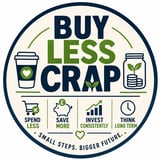
Regular readers of this website know I bang on about one thing constantly: buy less crap, invest the difference, give it time. I've always framed that as a wealth strategy — every pound you don't spend on stuff you don't need is a pound that can go to work compounding in an ISA or SIPP instead. But the longer I've lived by that rule, the more I've noticed it does something else too, almost as a side effect: it quietly shrinks your environmental footprint at the same time it grows your portfolio. This post is the other half of the 'buy less crap' story — not the money half, the planet half. It isn't a guilt trip and it isn't me pretending to be an environmental scientist. It's just an honest look at what all this 'stuff' actually costs once it leaves the shopping basket, in plain English, with sources, from someone who's spent a lot of time lately thinking about both his ISA and his bin.
── Why I Started Caring About More Than Just My Portfolio ──
It started with a boring realisation: the two habits that were making me richer — buying less and choosing more carefully — were the exact same two habits that would make me a smaller burden on the planet. I wasn't trying to 'go green.' I was trying to stop wasting money on things that ended up in a drawer, unworn, unused, forgotten. But unworn and unused things don't just represent wasted money. They represent raw materials that were mined or grown, energy that was burned to manufacture and ship them, and, eventually, landfill space or ocean plastic they'll become once we're done pretending we needed them. Buying less crap turned out to be a two-for-one deal I hadn't fully appreciated until I started reading the numbers on where all this 'stuff' actually goes.
── The True Cost of 'Stuff': Landfill, Oceans and Carbon ──
Let's start with the bit most of us never see: what happens after the item leaves the shop. The UK generates tens of millions of tonnes of household waste every year, and a meaningful share of it is stuff that was barely used before being thrown away — the gadget that worked for a month, the top worn once, the 'as seen on TV' gizmo that solved a problem you didn't actually have. Every one of those items carried an environmental cost long before it reached your door: raw materials extracted, factories running, container ships burning fuel across oceans, delivery vans criss-crossing towns. None of that cost shows up on the price tag. You pay it at the till in pounds; the planet pays it in carbon, water and landfill space, whether or not you ever use the thing you bought.
That's the part that changed how I shop. A £15 impulse buy isn't really a £15 transaction — it's a £15 transaction plus a hidden bill the planet quietly picks up. Multiply that by how many households are doing the same thing, on the same payday, for the same short-lived dopamine hit, and you start to see why 'just buy less of it' is one of the most quietly powerful environmental habits an ordinary person can adopt — no solar panels, no electric car, no lifestyle overhaul required. Just fewer trolleys full of things we didn't need in the first place.
── The Ocean Doesn't Want Your Fast Fashion ──
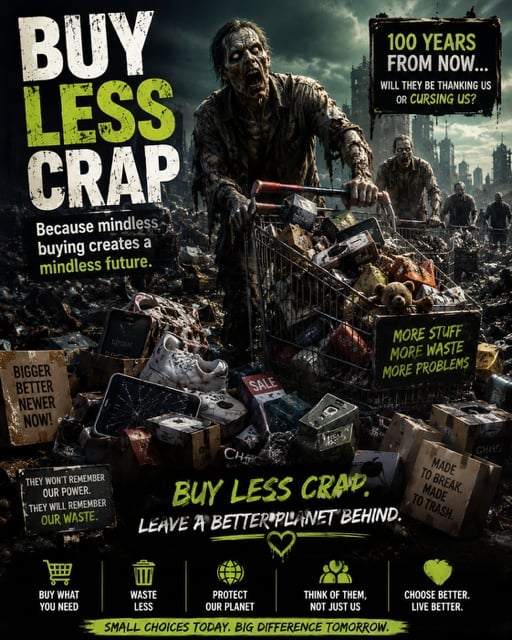
Fast fashion deserves its own paragraph because it's one of the clearest examples of 'buy less crap' as an environmental act, not just a financial one. The UK buys more new clothing per person than almost anywhere else in Europe, and a huge volume of it is worn only a handful of times before being discarded — WRAP, the UK's waste and resources charity, has estimated hundreds of thousands of tonnes of used clothing end up in UK household residual waste (i.e. landfill or incineration) every single year, much of it still perfectly wearable. Textile production is thirsty and carbon-intensive, and synthetic fabrics shed microplastics every time they're washed, a meaningful share of which end up flowing out to sea. None of that is a reason to never buy clothes again. It's a reason to buy less of it, buy it to last, and actually wear what's already in the wardrobe before adding to the pile.
── Every Purchase Is a Vote (And Most of Us Are Voting for More Landfill) ──
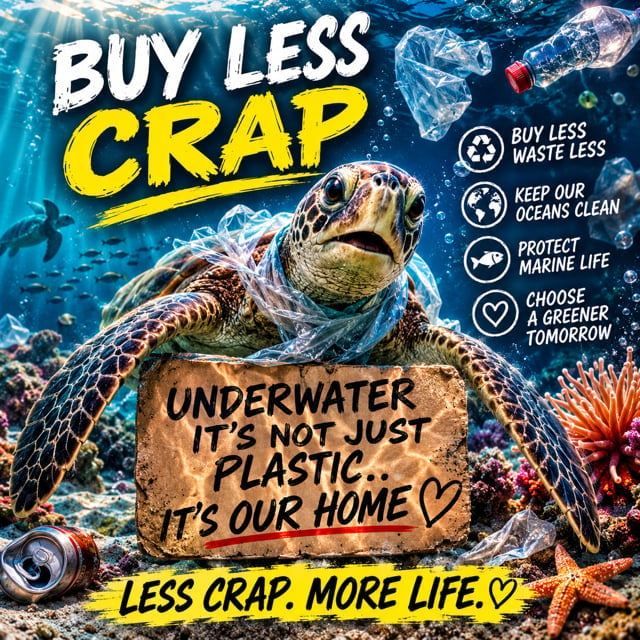
There's a phrase I like: every pound you spend is a vote for the kind of world you want more of. Buy a cheap, disposable version of something and you're voting for more cheap, disposable things to be made — and more of them to end up as waste within months. Buy less, buy better, or simply don't buy at all, and you're voting the other way, whether you meant to make an environmental statement or not. I don't think most overconsumption is malicious. It's mindless — a click here, a 'why not' there, a basket that grew from one item to six because the website made it so easy. The environmental cost isn't the result of anyone deciding to harm the planet. It's the accumulated weight of millions of small, thoughtless yeses.
── What Fuels Overconsumption? Debt, Debris and Drowning in Logos ──
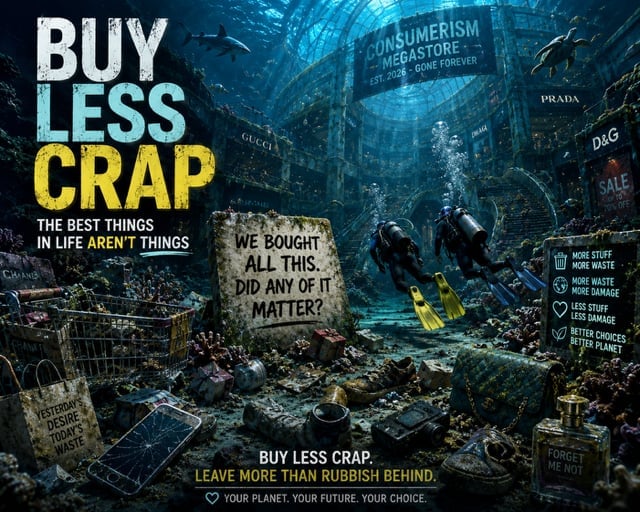
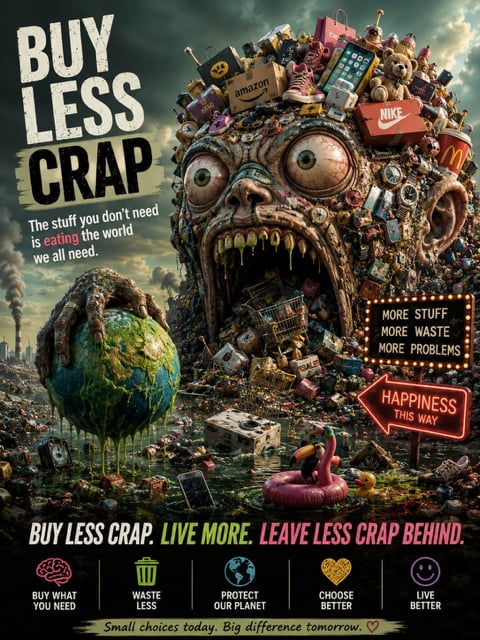
It's worth being honest about what actually drives all this buying, because it's rarely genuine need. It's marketing engineered to create a feeling of lack where none existed five minutes earlier. It's 'limited time' badges, influencer hauls, and a shopping app that's frictionless by design because friction is bad for sales. A huge amount of what fills UK homes — and eventually UK landfill — was bought not because life required it, but because a notification, an advert or a scroll session made it feel, briefly, essential. Strip away the marketing and most 'must-haves' turn out to be things we'd never have thought to want on our own. Recognising that manufactured urgency is half the battle, both for your bank balance and for the mountain of stuff it eventually becomes.
── The Two-For-One: Buy Less, Invest More, Waste Less ──
Here's the genuinely good news in all of this: you don't need two separate action plans, one for your finances and one for the planet. They're the same plan. Every time you ask 'do I actually need this?' before buying — the whole point of The Crap Test — you're simultaneously protecting your future wealth and quietly reducing demand for another cheaply-made thing destined for landfill. Every pound you redirect from mindless shopping into a low-cost ETF inside an ISA or SIPP is a pound that's no longer funding a fast-fashion top or a gadget you'll use twice. Buy less crap. Invest the difference. Waste less doing it. It's the same sentence whichever way you read it, and it's the closest thing to a genuinely free lunch I've found in either personal finance or sustainable living.
None of this means never buying anything, never enjoying a treat, or living like a monk. It means pausing before the basket fills up, asking whether the thing earns its place in your life, and being honest about how much of what we buy is landfill-in-waiting dressed up as a bargain. Small choices today — one less impulse buy, one more considered purchase — really can make a big difference tomorrow, for your bank balance and for the world your money, and your rubbish, leaves behind.
As ever, I'm not a financial adviser, an environmental scientist or anyone qualified to tell you how to live. I'm just sharing the thinking that's changed how I shop, and the numbers behind it, because I think it's genuinely useful. Nothing here is financial advice, and the statistics quoted are illustrative figures from public sources (such as WRAP) rather than a full academic citation — do your own research if you want the precise, current numbers for your own decisions.