I am 66 years old. I have owned — and I am not proud of this — three different gym memberships in my lifetime, and I used precisely none of them. The first one I cancelled after eight months when I realised I'd been paying £45 a month for the privilege of not going. The second one I kept for a year and visited exactly twice, once to sign up and once to cancel. The third one I actually went to for about three weeks, pulled something in my back attempting to lift a weight I had no business lifting, and never returned. I still paid for another six months. Call it a donation to the fitness industry.
But here's the thing I've learned the hard way: staying healthy doesn't require a gym membership, a personal trainer, a wardrobe full of Lycra, or any of the other paraphernalia the wellness industry would like to sell you. It requires, mostly, not being an idiot. Moving your body a bit each day. Eating food that used to be alive — or at least came from something that was. Sleeping properly. Having a laugh. And not treating your body like a rental car you're planning to return at the end of the weekend.
This is not a post about how to get a six-pack. I don't have a six-pack. I have what you might call a 'keg' — perfectly functional, does the job, just not going to appear on the cover of Men's Health anytime soon. This is a post about how to be healthy enough. How to feel decent in your own skin at any age. How to look after the only body you're ever going to get, without making your life miserable in the process. Think of it as health advice for people who find most health advice insufferable.
── The Best Exercise Is the One You'll Actually Do ──
The fitness industry has a vested interest in making exercise seem complicated. If it were simple — walk more, lift heavy things occasionally, get your heart rate up a few times a week — you wouldn't need the app subscriptions, the specialised equipment, the biomechanics assessments, or the 'optimised movement protocols.' You wouldn't need any of it. And an entire industry would collapse.
The single most effective exercise programme in the world is the one you'll stick to. That's it. That's the secret. If you hate running, don't run. If the thought of a spin class makes you want to fake your own death and start a new life somewhere else, skip the spin class. Find something — anything — that gets you moving and that you don't actively dread, and do that. Walk to the shops instead of driving. Take the stairs instead of the lift. Garden. Dance badly in the kitchen while the kettle boils. Carry all the shopping bags in one trip because you refuse to make two journeys. Chase your grandkids around the park until they get tired before you do (a goal I am still working toward).
Walking is genuinely one of the best forms of exercise available to humans. It's free. It requires no equipment. You can do it anywhere. It doesn't destroy your joints. You can listen to music, a podcast, or absolutely nothing — just the sound of your own thoughts and the occasional dog barking. A 30-minute walk every day reduces your risk of heart disease, improves your mood, helps with sleep, and — crucially — gets you away from screens for half an hour. If walking were a pill, it would be the most prescribed medicine on the planet. I try to walk every day. Sometimes I don't. That's fine too. The goal isn't perfection. The goal is most days.
── The 80/20 Approach to Eating (Yes, You Can Still Have a Biscuit) ──
I have tried every diet. The low-carb one where you eat nothing but meat and cheese and pretend vegetables don't exist. The one where you count points and end up gaming the system by eating seventeen rice cakes because they're 'zero points.' The one where you drink green sludge for breakfast and convince yourself it tastes great (it doesn't, and you're lying to yourself). The one where you only eat between certain hours, which mostly just meant I was very hungry by 11am and very grumpy by 4pm.
Here's what I've settled on after decades of nutritional experimentation: eat food, not too much, mostly plants. That's Michael Pollan's line, and it's the best seven words of dietary advice ever written. Notice what it doesn't say. It doesn't say 'never eat a biscuit again.' It doesn't say 'count every calorie.' It doesn't say 'eliminate entire food groups' or 'only eat things that taste like cardboard.' It says: actual food (things your grandmother would recognise as food, not industrially produced edible substances wrapped in plastic). Don't eat too much of it (stop before you feel like you need to lie down). And make plants the star of the show most of the time (vegetables, fruit, beans, lentils, grains — the stuff that grows in the ground and doesn't come with a list of 47 ingredients).
The 80/20 rule is my operating system for eating. 80% of the time, I eat sensibly — proper meals, plenty of veg, not too much processed stuff, a piece of fruit when I'm peckish instead of raiding the biscuit tin. 20% of the time, I eat whatever I fancy. A bacon sandwich. Fish and chips. A slice of cake with a cuppa. A full English breakfast on a Sunday morning because some traditions are sacred. The 20% stops the 80% from feeling like punishment. And because 80% of what I eat is decent, the 20% doesn't matter much in the grand scheme of things.
This approach has two enormous advantages. First, it works. You can eat well most of the time without feeling deprived. Second — and this is the clever bit — it removes the guilt. You don't 'cheat' on a diet that permits biscuits. You just have a biscuit. There's a world of psychological difference between 'I've been bad' and 'I'm having a biscuit because biscuits are nice.' One leads to shame, which leads to more biscuits. The other leads to a biscuit, which leads to getting on with your day.
── On Knees That Creak and Other Indignities of Aging ──
I am 66, which means my body makes noises it didn't used to make. Knees click. Back twinges. Getting out of a low chair sometimes requires strategic planning and a small grunt. This is not a design flaw — it's a feature. Bodies wear. Joints get creaky. Things that were easy at 30 require a warm-up at 60. The alternative to getting older is considerably worse, so I've decided to embrace the creaks as proof of continued existence.
But there are things that help. Moving regularly — not intensely, just regularly — keeps joints lubricated and muscles from seizing up. Stretching. I used to think stretching was something other people did, like Pilates or wearing matching socks. Now I spend five minutes stretching in the morning and my back thanks me all day. Staying hydrated helps more than you'd think — dehydrated joints are unhappy joints. And strength matters. You don't need to deadlift a car. Bodyweight exercises — squats, push-ups against the kitchen counter, carrying shopping bags, getting up and down from a chair without using your hands — these things maintain the strength you need for actual life, not just for impressing people at the gym.
The goal isn't to look like you're 25. That ship has sailed, and it wasn't that great a ship in the first place. The goal is to be able to get up off the floor without assistance, carry your own luggage, play with your grandchildren, and not spend your later years in a chair because your body gave up before you did. Functional fitness. Boring. Effective. Very on-brand for this website.
── The Joy of Being Terrible at Something ──
One of the unexpected pleasures of getting older is caring less about being good at things. When I was younger, I wouldn't try anything unless I thought I could be competent at it — a thoroughly limiting way to live. Now I'm happy to be terrible at things. I took up paddleboarding a few years ago. I fell off approximately 47 times in the first hour. I laughed so hard I nearly drowned. It was brilliant. I'm still terrible at it. I still go. There's something wonderfully liberating about doing something purely for the enjoyment of doing it, with no expectation of improvement, mastery, or Instagram-worthy results.
Find something active you're terrible at and do it anyway. Bad tennis. Clumsy swimming. Awkward dancing. Hiking where you stop for a pub lunch halfway through. Cycling very slowly on a heavy bike while everyone zooms past you in Lycra. The point isn't performance. The point is joy. Movement you enjoy is movement you'll keep doing. Movement you do out of obligation is movement you'll quit. Joy is a better motivator than guilt, every single time.
── Drink Water, You Dehydrated Fool ──
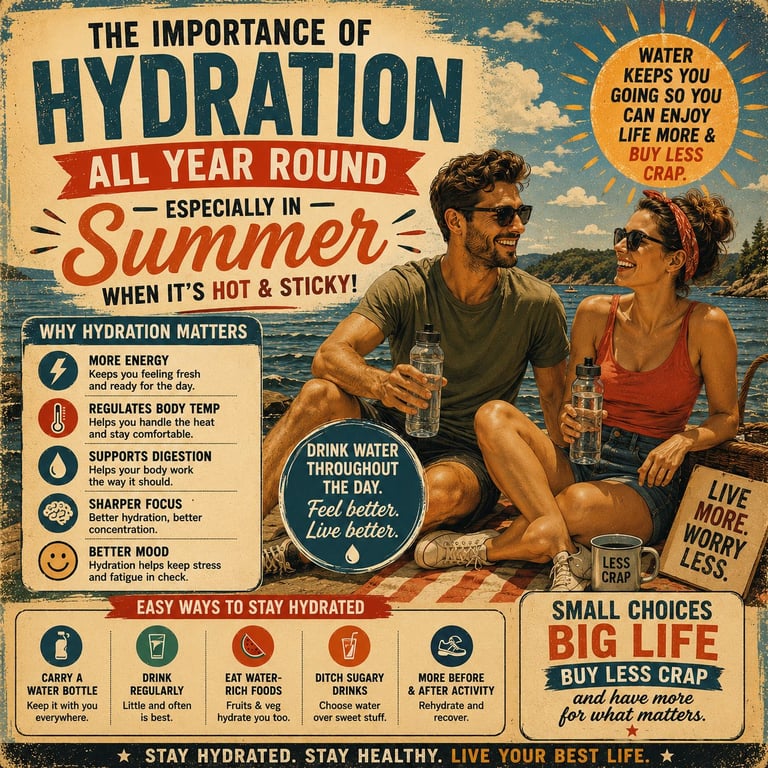
I am terrible at drinking water. Always have been. I'll get to 3pm and realise the only liquid I've consumed all day is two cups of tea and the residual moisture in a sandwich. Then I wonder why I have a headache and feel like I'm thinking through fog. Every single time.
Here's how I trick myself into drinking more water, because apparently at 66 I still need to be outsmarted by my own brain: I keep a water bottle on my desk where I can see it. If it's visible, I drink it. If it's not, I forget it exists. I also drink a full glass of water first thing in the morning — before tea, before breakfast, before anything. Dehydration builds up overnight while you sleep. A glass of water in the morning wakes your body up faster than caffeine (though I still follow it with caffeine, because I'm not a monster). And I've learned that sometimes when I think I'm hungry, I'm actually just thirsty. A glass of water and a ten-minute wait has saved me from countless unnecessary biscuits.
You don't need to measure your water intake in millilitres or carry around a two-litre jug like you're crossing the Sahara. Just drink when you're thirsty. Drink a bit more than you think you need. Notice when you haven't drunk anything for hours and do something about it. Your kidneys will thank you. Your skin will thank you. Your brain will stop operating at 60% capacity without telling you. Hydration is the least glamorous health advice and possibly the most effective. Naturally, nobody follows it because it's too simple to be interesting.
── Sleep: The Free Health Hack Nobody Wants to Use ──
Sleep is the closest thing to a magic pill that exists. It repairs your body. It consolidates memories. It regulates your mood, your appetite, your immune system. It costs nothing. It requires no equipment. And yet most of us — myself included for decades — treat it as optional, something to be sacrificed at the altar of productivity or late-night scrolling. I used to wear my lack of sleep like a badge of honour. 'I'll sleep when I'm dead,' I'd say, which is exactly the kind of stupid thing you say when you're young enough to get away with it. Sleep when you're dead? No, mate — not sleeping is what gets you dead sooner.
The research on sleep is unambiguous. Matthew Walker's book 'Why We Sleep' should be required reading for every human with a body. Chronic sleep deprivation is linked to heart disease, obesity, diabetes, impaired cognitive function, weakened immune response, and — perhaps most relevant to those of us who invest — significantly worse decision-making. You make dumber choices when you're tired. You're more impulsive, more emotional, more likely to buy things you don't need and sell investments at the worst possible moment. Sleep is not a productivity cost. It's a performance investment.
I try to get seven to eight hours a night. I don't always succeed. But I've built some habits that help: no screens for 30 minutes before bed (I read a book instead, like a Victorian gentleman), a consistent bedtime (even on weekends — yes, I'm that boring), and a bedroom that's dark, cool, and quiet. The difference between six hours and seven-and-a-half hours of sleep is the difference between feeling like I'm wading through treacle all day and feeling like an actual functioning human. Sleep more. Everything works better when you do.
── Laugh More, Stress Less, and Stop Comparing Yourself to 25-Year-Olds on Instagram ──
Stress will kill you. Not dramatically, not all at once, but steadily — raising your cortisol, inflaming your arteries, weakening your heart, making you age faster. The opposite of stress isn't relaxation — it's laughter. Genuine, proper, can't-breathe, snorting laughter. The kind where you forget what you were worried about because you're too busy trying not to choke on your tea.
I'm not going to tell you to meditate. Meditation is probably great. I've tried it. I spent twenty minutes thinking about what I was going to have for lunch. But I will tell you to find things that make you laugh. Spend time with people who make you laugh. Watch things that make you laugh. Read things that make you laugh. Laughter is free medicine with no side effects and no prescription required.
And — this bit matters — stop comparing your body, your health, your fitness, your diet, or your life to anyone else's, especially anyone under 30 on social media. Instagram is not real. Those abs are photographed in perfect lighting after a 48-hour dehydration protocol, and the person attached to them is probably just as miserable as everyone else. Comparison is the thief of joy in every domain — money, possessions, career, and health. The only relevant comparison is between you today and you a year ago. Are you moving a bit more? Eating a bit better? Sleeping a bit longer? Feeling a bit stronger? Then you're winning. Quietly, steadily, without fanfare — but winning.
── The Single Best Piece of Health Advice I Ever Received ──
A doctor once told me: 'Steve, your body is the only one you've got. Might as well look after it.' He said it with the weary tone of a man who'd spent forty years watching people treat their bodies like disposable packaging, only to discover — usually too late — that there's no returns policy and no exchange programme.
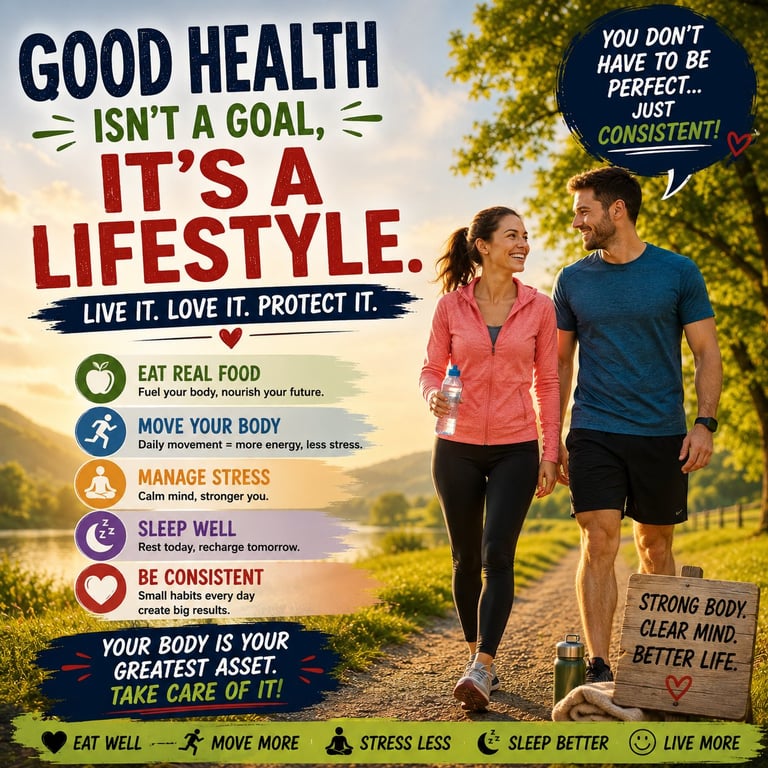
He wasn't telling me to become a triathlete or live on kale smoothies. He was telling me to do the basics. Move a bit. Eat sensibly most of the time. Sleep enough. Drink water. Have a laugh. Don't smoke. Don't drink so much that your liver files a formal complaint. And stop treating health like something you'll get around to later, because later has a habit of arriving with a doctor's appointment and a list of things you should have started doing ten years ago.
The basics work. They're not exciting. They won't get you a book deal or a YouTube channel. But they work. And the beauty of the basics is that anyone can do them. You don't need money, equipment, talent, or genetic luck. You just need to decide — today, and then again tomorrow, and then again the day after — that you're going to look after the one body you've got.
And if you fancy a bacon sandwich while you're at it, have the bacon sandwich. Enjoy it. Savour it. Then go for a walk. That's health, for normal people, in two sentences.
I'm not a doctor, a nutritionist, a personal trainer, or any kind of health professional. I'm a 66-year-old bloke who's made most of the mistakes and figured a few things out along the way. Nothing in this post is medical advice. Talk to your GP before making any significant changes to your diet or exercise routine. Your body, your health, your responsibility. Now go for a walk and have a glass of water. Go on.