
I need to open this post with an apology, because I recently wrote a very confident article on this website listing every book in the Wingle Universe, describing them in loving detail, arranging them in a pleasing grid, and informing the internet with total certainty that I had the complete set. I did not. There was one I'd left out entirely, and it is called I'm The Manager. Don't Ask Why. It has existed this entire time. I simply lost track of my own fictional kingdom, which is the most on-brand thing that has ever happened here — a book about an organisation that has completely lost the plot, forgotten by the organisation that published it. I'd like to say I'm embarrassed. I am, but mostly I'm impressed at how well the bit is holding up.
── How You Lose A Book ──
🐴 The Wingle Office Edition
Nobody Was Entirely Sure Why. Least Of All Him.
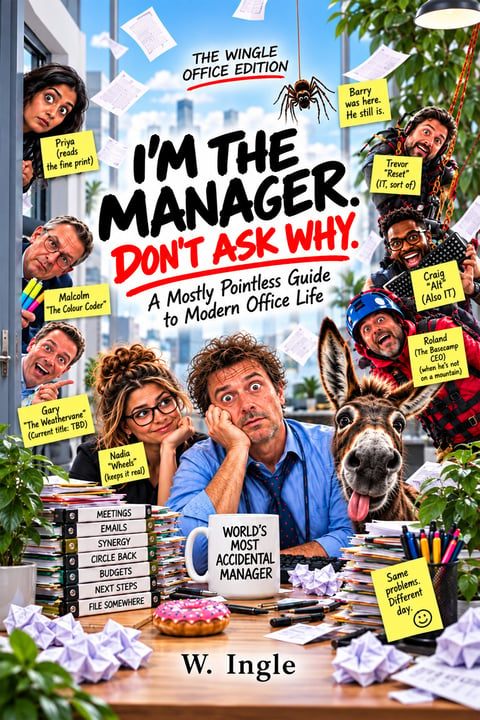
A man, a desk, a team, and a job title nobody bothered to explain. There's a wall of sticky notes held together by a colour-coded system that was explained aloud exactly once, several years ago, to somebody who has since left the company. There's a meeting to decide what to do about the meetings. And somewhere in the corner, a donkey who is quietly the only competent person in the building.
📖 Buy On Amazon If You Must →The one I forgot to mention. Don't ask why.
In my defence, and this is a thin defence, nobody keeps a proper inventory when they write comedy books on the side of a website about index funds. You write one. Then there's a second one in it. Then a third, and by the fifth you've stopped counting and started referring to it as 'the series', which is what people say when a thing has become structurally unstoppable. At some point the pile got tall enough that a book could sit in the middle of it and go unmentioned for an entire marketing campaign. Which is, if you think about it, exactly what middle management does to a person. Nobody means to lose you. You're just in the middle of the pile.
Start Here If You're New To This
This is the sixth book in a series I never intended to write. If you've arrived with no context at all, the full story — all five books I actually remembered, plus the donkey, plus a goat called Keith — is in this post:
👑 I Accidentally Wrote Five Books. Don't Ask Why. →Or go straight to the whole universe, every book and its cover, on the Wingle Universe book page.
── What This One's Actually About ──
I'm The Manager. Don't Ask Why. is the Wingle Universe pointed at the workplace rather than the throne room. Our man has been handed a desk, a team, a set of sticky notes and a job title that nobody has explained to him, and he has decided to make it work through sheer force of optimism. There is a man at a desk. There are colleagues. There is a donkey, because there is always a donkey. And there are sticky notes — an enormous, unreasonable number of sticky notes, arranged in a system that makes complete sense to exactly one person, who is not the Manager.
The plot is that there isn't one. That's the joke. Nobody was entirely sure why he got the job. Least of all him. There is a project, there is a deadline, there are meetings scheduled to discuss the meetings, and there is a sticky note somewhere on a monitor that says something so important nobody can remember writing it. If you have ever been promoted into a role that had no job description and then spent six months pretending you knew what it was, this book will feel less like satire and more like a photograph. It's not cruel about it. That's the difference. The Manager is not a villain. He's just a bloke who said yes, and who is now standing in an open-plan office holding a mug, waiting for somebody to tell him what he's supposed to be doing. Nobody does. The donkey would tell him. Nobody asks the donkey.
── The Meeting About The Meeting ──
There's a chapter that I'm proud of, and it's the one where they hold a meeting to decide what to do about the meetings. It takes forty minutes. Fourteen people attend. Two of them are there by mistake and one of them is there for the second time that day. At the end, a decision is reached, and the decision is that a smaller group should be formed to look into it. Everybody leaves feeling that progress was made. This is not exaggeration for comic effect. I have been in that room. So have you. Some of you are in it right now, reading this on a phone under a table. I see you. The book sees you.
What makes it work — and this genuinely surprised me when people started telling me so — is that it's never cruel to any individual in it. Every single person in that meeting is doing something that seems reasonable from where they're standing. That's what makes institutions so spectacularly resistant to being fixed. Nobody is sabotaging anything. Everyone is being sensible, in a direction, about something that doesn't add up. The donkey is the only one who has ever looked at the whole thing at once, and the donkey is a donkey, so nobody takes the minutes of what he says.
── The Sticky Note Situation ──
The sticky notes deserve their own paragraph, because readers keep bringing them up. In this book the office is held together by a colour-coded system that has been explained aloud exactly once, several years ago, to somebody who has since left the company. New starters are taught it by other relatively new starters, who learned it from somebody with partial knowledge, who is now working remotely and unreachable. The result is a wall that looks organised and functions as a lottery. I've been told by three separate people that this is the most accurate thing I've ever written and that I should not have written it. I take that as a review.
The moral, insofar as there is one, is that the note you wrote to yourself six months ago is now a stranger, and the stranger has opinions, and you're going to do what it says anyway.
── Do You Need To Have Read The Others? ──
No. This one stands up on its own, which is partly why I think it slipped through the net. If you've read any of the others — I'm The King, I'm Still The King, I'm The King Now, The Wingle Chronicles — you'll spot the same universe, the same donkey, the same creeping sense that the organisation is running the people rather than the reverse. If you haven't read any of them, this is a perfectly good place to start, though it is arguably the most pointed one, because it's the one closest to your actual Monday.
── And The Money Bit, Because This Is Apparently A Money Website ──
You knew it was coming. The reason this book belongs on this site, and not just on the shelf beside the others, is that the thing it's laughing at is a spending problem. Every meeting about the meeting is paid time. Every reorganisation that changes the boxes on the chart and nothing else is money that went out the door and bought a new diagram. Every year that a system is maintained because somebody is too senior to be told it's broken is a year of somebody's salary spent protecting a decision rather than doing the work. It's lifestyle creep with a landline. It's buying the thing that looks like progress instead of the thing that is progress, at industrial scale, and it happens in organisations because it also happens in people.
So the lesson is the same one as every other page on this website: be suspicious of the thing that looks productive and isn't, and put your resources into the thing that actually moves. Buy less crap. Including at work. Especially at work, where somebody else is paying for it and nobody is checking.
── Where To Get It ──
I'm The Manager. Don't Ask Why. is available now on Amazon, in the usual formats. There's a link right here in this sentence, and another one at the bottom of the page if you'd rather scroll past me making a fuss about it. I'm not going to over-explain the purchasing process to you. You've bought a book before. You know how shops work.
If you'd rather meet the rest of the Wingle Universe first, the whole lot lives on the book page of this website. There's also a longer piece I wrote recently explaining how a website about buying less crap ended up publishing comedy about a donkey, which is worth reading before this one if you want the full picture: I Accidentally Wrote Five Books. Don't Ask Why. — which, given what's just happened, is a title that has aged extremely badly. Spoiler for that one: I still don't know why. I set out to explain index funds. The donkey is doing better than I am and has no overheads.
As ever, the small print: this is a blog post about a comedy book, so it is absolutely not financial advice, I am not regulated by the FCA, investments go down as well as up, and no sticky note in this office has ever been reviewed by anyone with authority to make a decision.