
Every winter, the same conversation happens in kitchens across Britain. The lights flicker. The heating falls silent. Someone says "where's the torch?" and the entire household discovers, simultaneously, that the answer is probably "in the shed, behind a bicycle, with no batteries in it."
A power cut is rarely a disaster. It is an inconvenience that turns into a disaster only if you were completely unprepared for it. And the good news, which is the whole point of this post, is that being prepared does not mean buying a generator or a bunker. It means a short list of ordinary things, kept in sensible places, plus a plan to call the right number.
I wrote all of this down in The Practical UK Home Emergency Handbook, and this post is the short version of the power-cut chapter — the part you can act on this week without spending anything.
The power cut checklist: 12 things worth keeping at home
This is the list I would stick on the inside of a kitchen cupboard door. None of it is expensive. Most of it you probably already own.
The UK power cut checklist
- ✓A torch in a place you can find in the dark — Not in the shed. Not in the loft. In the drawer you could reach blindfolded.
- ✓A head torch — Both hands free to hold a candle, a child, or a cup of tea.
- ✓Spare batteries, checked — Batteries in a drawer since 2019 are a decoration, not a plan.
- ✓A battery or wind-up radio — The power being out is exactly when you cannot charge your phone for updates.
- ✓A charged power bank per phone — One charge is roughly a full phone battery. Keep it topped up.
- ✓Bottled water — About three litres per person per day, plus extra for pets. Build it up gradually.
- ✓Tinned food you would actually eat — Beans, soup, tuna, fruit — much of it needs no cooking.
- ✓A manual tin opener — The electric one has stopped being electric. Learn from my mistakes.
- ✓A first aid kit — Stubs, cuts and groping around in the dark go together.
- ✓Warm layers and blankets — You can heat a person much more cheaply than a house.
- ✓Keys, medication, documents — Easy to find fast, in the same place every time.
- ✓105 written on the fridge — Free national power cut helpline. You will not remember it in the dark.
That is genuinely the whole thing. If you can tick most of that list, a winter storm stopping the lights for a night becomes an evening with candles and a radio, rather than a small crisis. The handbook goes further — quantities, where to store everything, what to do with the freezer — but you can start tonight with the free bits.
What the lights on your electricity meter actually mean
This is the question that sends more people to search engines during a power cut than any other. When the house goes dark, half of Britain goes out to look at the little box under the stairs, sees a green light or a red light or a blank screen, and has absolutely no idea what it is trying to tell them.
Modern smart meters — the sort with a small digital display, like the popular i HD3 models — show your usage and, on the newer generation, will indicate whether the supply is live. The useful distinction during an outage is this:
- •The meter is completely dark. If the display is dead and nothing responds, there is very likely no supply reaching the property at all — a genuine network outage. Call 105.
- •The meter is still showing a reading, but the house is dark. The supply is reaching you, so the problem is more likely inside the property — a tripped consumer unit, a blown circuit, or a fault on one of your own appliances. Check your consumer unit before doing anything else.
- •The meter shows a warning or a message. Note what it says — meter model, light colour, message. Your network operator or supplier will ask.
A note for anyone on a prepayment meter: making sure it has credit before a storm arrives is one of the simplest bits of preparation there is, and it is the one people forget at the exact moment they most need it. I go through meter lights, consumer units and prepayment in much more detail — with the "when to stop poking it and call someone" bit spelled out — in the handbook.
Who to call when the power goes out
Call 105. It is free from landlines and mobiles anywhere in Great Britain, and it connects you to your local electricity network operator — the people who actually fix the cables, rather than your supplier, who bill you. That distinction matters when your street has gone dark and you want an update rather than a tariff discussion.
Ninety-nine times out of a hundred, 105 is the right answer. The exception is a genuine emergency: smoke, fire, sparks, an injured person, or a power line down. In that case, 999. And never approach a fallen overhead line, however far away it looks and however small the problem seems. The book has a line about not doing anything heroic in flip-flops, and it was not written entirely in jest.
Before you call, two quick checks that take ten seconds and save everyone time: look outside to see whether the neighbours are out too, and check your own consumer unit. That is why the checklist starts with a torch. You cannot read a fuse box by the light of the one you were trying to find.
Water, food and the freezer
Most power cuts last a few hours. Some, especially after winter storms, last days. The rules for getting through them are wonderfully simple:
Water: about three litres per person per day for drinking and basic hygiene, plus extra for pets. If the world has gone properly quiet, fill the bath before it gets worse. And if your water supplier issues a boil notice, follow it exactly. I wrote a whole separate book about that, so I won't pretend it is a footnote — the Practical UK Emergency Water Handbook covers quantities, storage and what to do when the taps go dry.
Food: keep the freezer shut. Every time you open it to "check", you let out cold air. A full freezer keeps food safely for roughly a day or two if left closed, and you should eat the most perishable things first if you are certain they have not thawed fully. Tinned food that needs no cooking is the backbone of any pantry plan — beans, soup, tuna, fruit — and most of it keeps for two to five years if stored cool and dry.
On a budget? Do it in three tiers
- This week, for nothing: find the torch, check the batteries, save 105 to your phone, learn where your stopcock lives, write the plan on a note stuck to the fridge.
- Next month, for a tenner: a head torch, a battery radio, a couple of power banks, extra water, and tinned food you will actually eat.
- Over time: blankets, a small cooler, copies of key documents. No rush. Preparation is meant to reduce panic, not cause it.
Why a power cut is a classic "buy less crap" moment
There is a whole industry selling emergency kit: tactical torches, freeze-dried food for a family of four for forty years, solar chargers the size of a briefcase. Most of it is fine. Very little of it is necessary. What actually gets you through a power cut is a torch that works, water you can drink, food you like and a number you know — which is an oddly good fit for everything else on this website.
Buy less. Buy better. Buy it once, keep it in a place you can find it, and spend the difference on something you will actually use. The Practical UK Home Emergency Handbook is the long version: power cuts, water shortages, storms, flooding, snow, heat, family plans, pets, medication, and the budget tiers that keep the whole thing sensible. If you would like it in a size that is easier to read, there is also a large print edition.
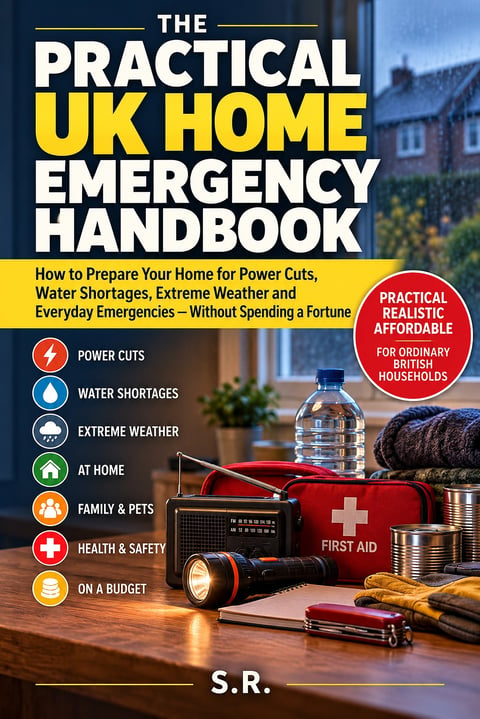
The Practical UK Home Emergency Handbook
A plain-English, budget-first guide to preparing your home for power cuts, water shortages, storms and everyday emergencies.
When it's not just the lights: the What Now? manual
A power cut on its own is manageable. The problem is that it rarely arrives alone. The pipe bursts in the loft the same night the boiler stops, the smoke alarm starts chirping at 2am, or there's water coming through the ceiling and no obvious way to stop it. That is not the moment to be reading a 300-page book from the beginning.
What Now? The Practical UK Emergency Manual is the companion I keep for exactly that: 200 household emergencies, each set out the same way — what's happening, do this now, then don't and call, be ready next time. Power, water, fire, weather, health and money, in plain English, in a layout you can find your way around with a torch in your hand. No stories. No waffle. Just what to do.
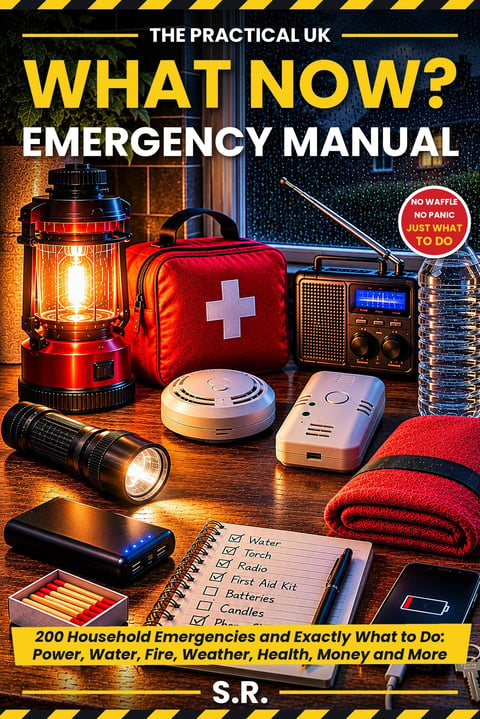
What Now? The Practical UK Emergency Manual
200 household emergencies and exactly what to do — also available in large print.
Keep it on the shelf next to the handbook. When the house has other plans, you'll want the answer in thirty seconds, not thirty pages.
If you want to go further: the Prepper’s Guide
A night without power is survivable with a torch and a tin of beans. A fortnight of snow, or a stretch where the taps and the supermarkets both stop being reliable, needs a bit more than that — and it needs to be affordable, because a house full of freeze-dried rations is just buying a lot of crap you’ll never use.
The Practical UK Prepper’s Guide: Prepping Without the Prepping is the next step in the series: two weeks to three months of self-reliance for an ordinary British home, built from a normal weekly shop rather than panic buying. Real shelves instead of a bunker, no camouflage, plenty of tea. It starts at the fortnight level almost anyone can manage — food, water and warmth — and grows from there only if you want it to.
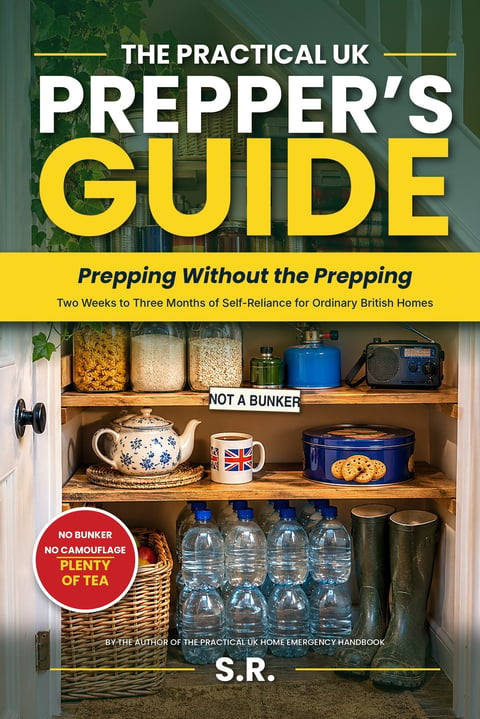
The Practical UK Prepper’s Guide: Prepping Without the Prepping
Two Weeks to Three Months of Self-Reliance for Ordinary British Homes — no bunker, no camouflage, plenty of tea.
For when a torch and a couple of tins aren’t quite enough — and you’d rather build it calmly than buy it in a panic.
Frequently asked questions
What is the single most useful thing to have ready for a power cut?
A torch you can actually find in the dark — and honestly, so is knowing who to call. Beyond that: a head torch so both hands stay free, a battery-powered or wind-up radio, charged power banks, a first aid kit, bottled water, tinned food you will actually eat with a manual tin opener, warm layers and blankets, and easy access to keys, medication and important documents. The book covers where to store everything, how much of each item you need and how to do the whole thing on a budget.
What do the different lights on my electricity meter mean?
Smart electricity meters use a display to show your current usage and, on newer ones, whether the supply is live. If the meter is dark and shows nothing at all during an outage, that usually means the supply has gone. If the meter still shows a reading while the rest of the house is dark, the problem is more likely inside your property — a tripped consumer unit or a fault — rather than a network outage. The handbook explains how to read the meter, how to find your consumer unit and when to stop poking things and call 105.
Who do I call during a power cut in the UK?
Call 105 — the free national power cut helpline. It works across all of Great Britain, is free to call from landlines and mobiles, and connects you to your local network operator. Before calling, check whether neighbours are affected too and check your own consumer unit. Never call 999 for a power cut unless there is a genuine emergency such as fire, smoke, injury or a power line down.
How long does tinned food last, and how much water should I store?
Most tinned food keeps for two to five years if stored somewhere cool and dry, and it does not need cooking — much of it is safe to eat straight from the tin. A common rule of thumb is about three litres of water per person per day for drinking and basic hygiene, plus extra for pets. Start with what you can carry home from the supermarket and build up gradually rather than buying a pallet of water you will never use.
What are the most common causes of winter power cuts in the UK?
The regular culprits are storms bringing down overhead lines, ice and snow, trees falling on lines, flooding, and local equipment faults such as a damaged cable or a substation issue. Most outages are restored within a few hours, but storms can leave rural areas without power for days. Knowing how to report the outage, where your torch is and what your household plan is matters more than owning an expensive generator.
What do I do when the power is out and something else goes wrong — a burst pipe, a fire alarm, a leak?
That is exactly the situation What Now? The Practical UK Emergency Manual is built for. Each of its 200 household emergencies is set out the same way: what's happening, do this now, then don't and call, and be ready next time. It covers power, water, fire, weather, health and money in plain language, in large print, so you can find the right page in a hurry with a torch in your hand rather than reading a story about someone else's flood.
Do I need to spend a lot of money to be prepared?
No. The Practical UK Home Emergency Handbook is written specifically for ordinary British households on ordinary budgets and is built in tiers: the free things you can do this week (find the torch, learn where the stopcock is, save 105 to your phone), the cheap things next month (a head torch, a battery radio, extra water), and the rest over time. Preparation is supposed to reduce panic, not create it.
Emergency advice in this article is general and based on UK network operator guidance. Always follow the instructions of your network operator, water supplier or emergency services in a live incident.