
● Out Now · On Amazon
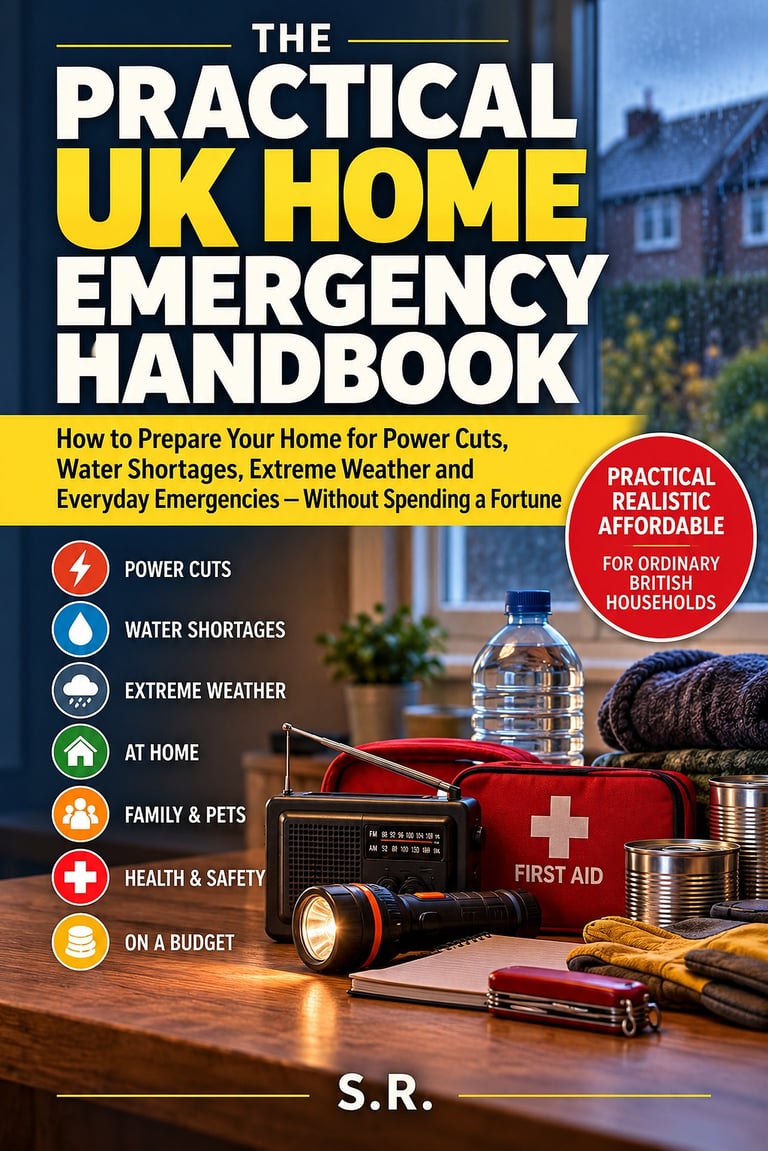
The Practical UK Home Emergency Handbook
How to Prepare Your Home for Power Cuts, Water Shortages, Extreme Weather and Everyday Emergencies — Without Spending a Fortune
By S.R.
Power cuts, water shortages, storms, snow, floods and the everyday disasters. A sensible, budget-first plan for ordinary British households — because being prepared is cheaper than being caught out, and being told to "stay calm" has never worked for anybody.
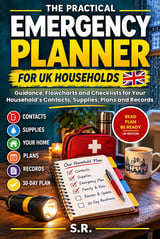
Best used with
The Practical Emergency Planner for UK Households
Gets your household’s answers out of one head and into one place — so anyone can act on them.
Out now on Amazon →No bunkers. No freeze-dried meals for eighteen. No spending a fortune.
Available in Kindle, paperback and large print.
What Is This Book?
The Practical UK Home Emergency Handbook is a plain-English guide to getting your home through power cuts, water shortages, extreme weather and everyday emergencies — for ordinary British households on ordinary budgets. It shows what to keep at home, what to do during a blackout or water outage, how to prepare for storms, floods, snow and heat, and how to look after family, older relatives and pets. It is serious about the things that matter and funny about the things that don't, because a book demanding you "remain calm" is, historically, the least calming object in the house.
The Story Behind It
It Started With One Bad Night (And A Torch In The Shed)
It was a Tuesday. The power went out at twenty-past-nine — and in the dark that followed, a grown man with a mortgage, a smoke alarm and opinions discovered he owned three candles, no matches, and a torch that had been in the shed since the Jubilee and was, on inspection, entirely decorative.
The freezer hummed a few sad farewells. The router's little green lights went out like a small disappointed audience. And somewhere next door, a neighbour's generator started up with the smug, well-oiled confidence of a man who had absolutely prepared for this.
Nobody died. Nobody even had to be rescued. But sitting there in a dark kitchen with a phone on eight percent, a tin of beans and a half-formed plan involving a camping lantern and a bad idea, one thought became unavoidable: why on earth didn't I sort this out before?
That was the moment this book began — not as a list of things to buy, but as a list of things to know. This is the handbook that long dark evening needed: the honest, unfussy, occasionally ridiculous story of getting a home ready without spending a fortune or turning the spare room into a bunker.
It is funny about the small humiliations — the candles with no matches, the batteries from 2019, the torch kept in the one place it will never be needed — and serious about the things that actually matter: where the stopcock is, how long the fridge contents are safe, what to do when the taps run dry, and which number to call when the lights come back somewhere else on the street and not at your house.
A story of a dark evening, a daft torch, and a plan that finally works. With a happy ending you can actually prepare for.
What's Inside
Seven areas, all of them things that actually happen in Britain, all of them sorted for real budgets.
Power Cuts
Torches, batteries, candles done safely, keeping the freezer cold, the boiler and the router, and why the meter cupboard is not a disaster zone.
Water Shortages
How much water actually matters, what to store, what to fill, boiling notices, and the bath you never thought would earn its keep.
Extreme Weather
Storms, floods, snow, ice and heatwaves — what to do before, during and after, and which grit bin you should probably know about.
At Home
The kitchen cupboard that was already an emergency kit, documents, keys, phones, heating alternatives and the flickering fuse box.
Family & Pets
Children, older relatives, neighbours, medication and the dog who eats anything. Simple plans that survive contact with real life.
Health & Safety
First aid basics, smoke and carbon monoxide alarms, food safety in a blackout, and not doing anything heroic in flip-flops.
On A Budget
Cost tiers, so you can do the free things this week, the cheap things next month and the rest when money allows.
The whole point
Most of it costs nothing, because most of preparation is knowing where things are and what to do next.
Preparation In Tiers — Not In One Panic Purchase
Nobody needs to buy a whole bunker in a weekend. Start where you are.
01
This week, for nothing
Find the torch. Locate the batteries. Write down the water supplier and the power network operator's number. Learn where the stopcock lives — it has been there the whole time.
02
Next month, for a tenner
A battery radio, extra water, a spare power bank, tinned food you will actually eat, and a cheap head torch so both hands stay free.
03
Over time
Build the sensible extras at your own pace — a small cooler, a camping stove used outdoors only, copies of key documents. No rush. Preparation is supposed to reduce panic, not create it.
Serious Where It Counts. Honest Where It Matters.
Most preparedness books are written by people who already own a generator and a north-facing larder. This one started with a real power cut on a real Tuesday evening, a torch in a shed, a neighbour's smug generator, and the dawning realisation that "I'll sort that one day" is not a plan. It is written for the rest of us: the candle drawer nobody inventories, the batteries from 2019, the freezer you're terrified to open after four hours without power.
So it tells a story — the small, funny, deeply relatable story of getting caught out and doing something about it — and then it gives you the handbook the story needed. Laugh at the torch. Learn where the stopcock is. That is the whole trick.
So it does the unglamorous bits properly — what to do first, what actually matters, what can safely wait. And it does them with the sort of humour that comes naturally when your only torch has been in the shed since the Jubilee.
Prepared is not paranoid. Prepared is just cheaper than being caught out.
Out Now On Amazon
Power cuts, water shortages, storms, floods, snow, heat and everyday emergencies — sorted, sensibly and on a budget.
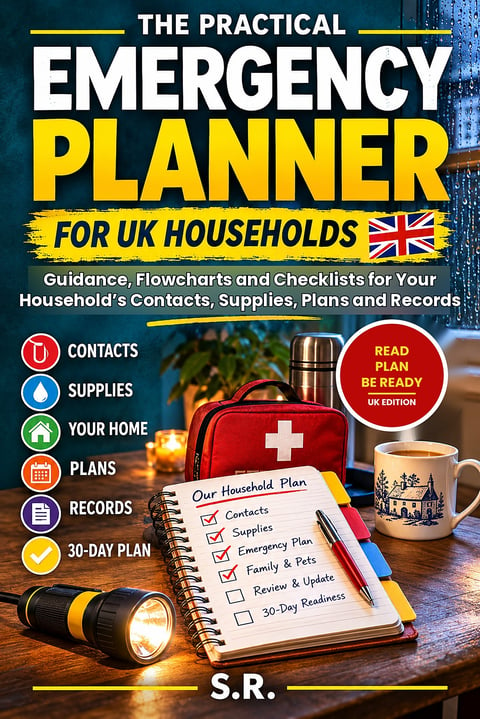
The Practical Emergency Planner for UK Households
This handbook goes with the Planner, which gets the knowledge out of one person’s head and into one place: where the stop tap is, who holds the spare key, which number to ring in a power cut, which tablets Grandad takes and when. Leave it lying there, and a partner, a teenager, a sitter or a visiting relative can act on all of it.
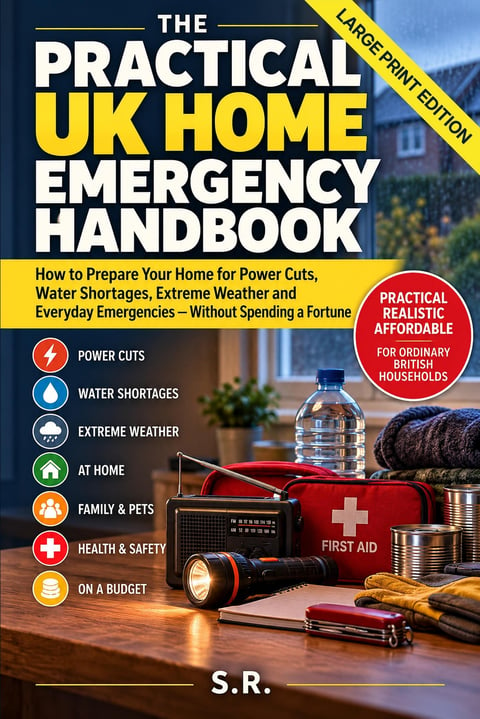
Large Print Edition
Same handbook, bigger type — easier on the eyes, and a sensible gift for parents or grandparents who want a paper copy they can actually read without hunting for the glasses. Available now in large print on Amazon.
Get the large print editionThere are more books too — comedy books about a King, a Donkey and a goat called Keith, a midlife audit, a book about beans, and the rest of the Practical UK handbooks.
More Practical UK Handbooks
Same approach — plain English, real budgets, no drama. All four are out now on Amazon, and all are available in large print editions as well. The Emergency Planner is out now too, in the same large print range as the rest of them, and You’d Be Dead By Now is out now too — also in large print.
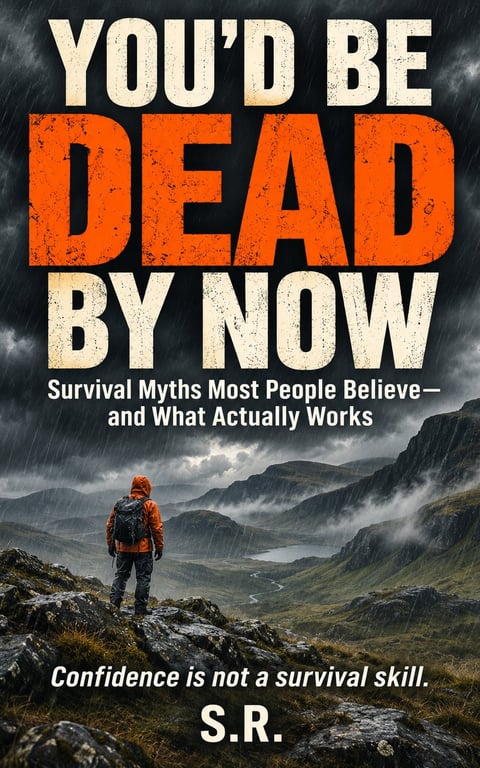
You’d Be Dead By Now
Survival Myths Most People Believe—and What Actually Works
You reckon you’d know what to do. You wouldn’t.
Suck the poison out of a snake bite. Drink your own wee when the water runs out. Rub frostbitten fingers to warm them up. Follow the moss and it points north. Get out of cold water fast and swim for shore. Leg it if you meet a bear. Ration your water so it lasts.
Do any of that and you’ll end up hurt, or worse. And yet most of us believe at least half of it.
You’d Be Dead By Now goes through the survival advice we’ve all soaked up from films, telly and the school playground, explains plainly why it gets people killed, and then hands you the version that genuinely works. It’s for the night your phone dies, the light fades, the weather turns and nobody has a clue where you are — when getting yourself out of it is the only option left. You may well surprise yourself the moment there’s no plan B.
What’s in it
- The survival mindset: Your brain packs in before your body does. How to catch fear before it tips into panic, accept where you are fast, and train the will to keep going.
- Cold, wet, wind and heat: How fit, sensible people slide into hypothermia, why several thin layers beat one big coat, and the quiet way heat does for you.
- Water that wants you dead: Cold water shock, Float to Live, rip currents, tides, mud, flooded roads and thin ice — and why jumping in after someone so often ends with two bodies.
- Shelter: The moves that matter in the opening ten minutes, making do with what's in your bag, and building something from nothing when you have to.
- Fire: Rubbing two sticks is a last resort, not a plan. Start one with batteries, foil or a lens, find dry wood in pouring rain, and keep it alive till morning.
- Water you can drink: Clear isn't clean. Where to look when there's no tap in sight, and how to make it safe with a can, a bottle or the sun.
- Finding your way: No compass, no phone — just the sun and the stars. Plus the one decision that matters most: sit tight, or start walking?
- Getting found: How to call for help anywhere on earth, which signals rescuers genuinely watch for, and what to do when a helicopter can't land.
- Food when you're truly stuck: You won't starve in a week. Foraging is more likely to poison you than feed you — and here's what's genuinely safe if you're desperate.
- First aid when help is hours away: Bleeding, broken bones, dirty wounds and infection — plus the home remedies that quietly make everything worse.
- Animals: Cows, dogs, bears, big cats, snakes, ticks and stings: stand your ground, back away slowly, or leave well alone — and which is which.
- Extreme places: Lightning strikes, desert and dry country, and wildfire — the rules that change completely when you leave green Britain behind.
- Everyday survival: Choking, CPR, getting out of a sinking car or a burning house, a crowd crush, spotting a stroke or heart attack, and keeping yourself safe on the street.
- Simple self-defence: Notice trouble early, de-escalate with your mouth, and learn escapes that work — the aim is to get away, never to win.
- The 24-Hour Test: A safe, step-by-step challenge at home or in the garden that shows you honestly how ready you actually are.
Every chapter follows the same pattern: the myth everybody repeats, the truth behind it, the steps to take in order, a “When you have no choice” section for the point where it’s all gone sideways, and a ten-second recap you can cling to under pressure. Plain black-and-white diagrams and yes/no flowcharts take you straight to the right move, even when your head has gone blank. It speaks your language rather than jargon, and there’s a dry laugh in there too — because nobody copes with a real emergency without the odd bit of gallows humour.
Hillwalker, camper, long-distance driver, traveller, or simply someone who’d like to think they’d hold it together when it matters — this is the one to have on the shelf.
Being confident about survival isn’t a skill. Doing the right thing is.
New from S.R. — out now on Amazon UK, in standard and large print.
Questions about the book +
- What is You'd Be Dead By Now about?
- You'd Be Dead By Now: Survival Myths Most People Believe—and What Actually Works is a survival book by S.R. It takes the survival advice most people pick up from films, TV and the playground — sucking snake venom, drinking urine, rubbing frostbite, following moss, swimming for shore in cold water, running from a bear, rationing water — explains why it is wrong, and gives you what actually works.
- When is You'd Be Dead By Now out?
- It is out now on Amazon UK as a paperback, in a standard and a large print edition. Both buy links are here and on its page on this site.
- Is You'd Be Dead By Now by the same author as The Practical UK Home Emergency Handbook?
- Yes. Both are by S.R. The Home Emergency Handbook covers household emergencies — power cuts, water shortages, storms, floods and heat. You'd Be Dead By Now covers being outside, in the weather, injured or lost and away from help.
- What should you actually do if you fall into cold water?
- Float on your back and control your breathing before doing anything else. Cold water shock in the first minute makes people gasp and thrash, which is what kills them. Once you can breathe, call for help and work out the nearest safe way out — it is not always the shore you can see. The book covers cold water shock, Float to Live, rip currents, tides, and why going in after someone so often ends with a second casualty.
- Is it true you should ration your water in a survival situation?
- Usually, no. Unless you have a fixed supply, a known wait and rescue already on the way, sipping small amounts just speeds up dehydration. Drink what you have and find more. The book explains the rare situation where rationing is sensible — and why it is not the default.
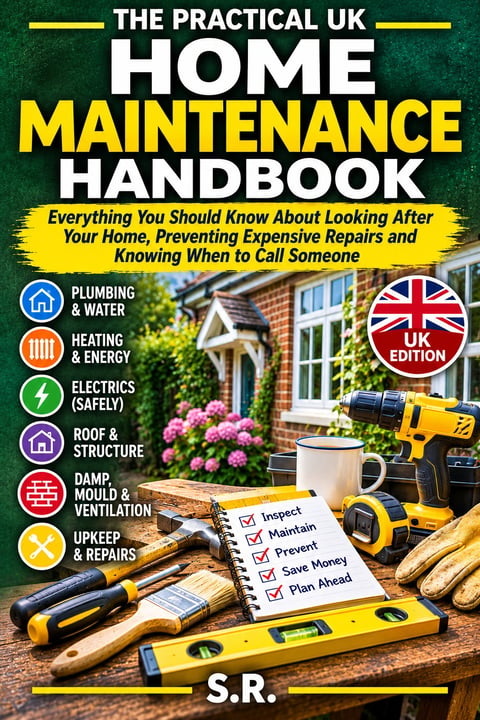
The Practical UK Home Maintenance Handbook
Everything You Should Know About Looking After Your Home, Preventing Expensive Repairs and Knowing When to Call Someone
Most expensive repairs start as small, cheap, boring ones. A dripping tap. A blocked gutter. A strip of bath sealant that has gone a colour best described as pond. Nothing happens for months — and then everything happens on a Sunday evening in January, usually with water coming through the kitchen ceiling.
This one shows ordinary British households how to understand their home, catch problems while they are still small and cheap, do the simple jobs safely, and know — with confidence — when to call a professional. Victorian terrace or new-build flat, owner or renter, it is written for anyone who owns a screwdriver but is not quite sure where it is. Calm, realistic and often funny, with a spaniel called Biscuit, a neighbour called Dave who owns every tool ever made, and a retired district nurse who holds the ladder.
Inside you’ll find
- ✓A safe twice-yearly inspection with a torch, notebook and binoculars
- ✓Stopcocks, taps, toilets, bathrooms, drains, gutters and hidden leaks
- ✓Boilers, radiators, heating controls, insulation and draughts
- ✓Condensation, damp and mould — which is which, and how not to be sold the wrong cure
- ✓Roofs, chimneys, walls, cracks, foundations, windows and doors
- ✓Floors, stairs, decorating, gardens, fences, paths, sheds and trees
- ✓Electrics, gas, carbon monoxide and asbestos — what to check, never to touch
- ✓Finding a good tradesperson, comparing quotes and spotting doorstep chancers
- ✓Seasonal checklists, 16 worksheets, a glossary, common questions and UK contacts
By the author of The Practical UK Home Emergency Handbook. Practical. Realistic. Affordable.
The Practical Emergency Planner for UK Households
Your Household’s Contacts, Supplies, Plans and Records — The Companion to The Practical UK Home Emergency Handbook
What would happen in your house if the lights went out tonight?
Would anyone know where the stop tap is? Who holds the spare key? Which number to ring for a power cut, or what tablets Grandad takes and when? In most homes those answers live in one person’s head — and that person isn’t always there. The Planner gets them out of your heads and into one place, so a partner, a teenager, a visiting relative or a sitter can act on them. It also includes plain-English guidance for every part of the plan, quick numbers for England, Scotland, Wales and Northern Ireland, and six flowcharts for what to do first when something goes wrong.
Inside you’ll find
- ✓Plain-English guidance for every part of your household plan
- ✓Quick reference numbers for England, Scotland, Wales and Northern Ireland
- ✓Six flowcharts for what to do first when something goes wrong
- ✓Checklists for the home kit, departure bags, car kit and first-aid kit
- ✓The questions every plan should answer — power cuts to school pick-ups and sitters
- ✓A 30-Day Plan of short, simple jobs, most costing nothing
- ✓Monthly checks and a six-month review to keep it current
- ✓A short page on what never to write down
Written for UK homes, and written for renters and owners, flats and farmhouses, people living alone and busy families. The blank write-in pages are in the paperback, hardback, A4 and large print editions — many readers keep the Kindle edition on their phone and the printed planner by the torch.
Practical. Realistic. Affordable.
Best used together
The Planner is the workbook for The Practical UK Home Emergency Handbook: the Handbook tells you what to do and why, the Planner is where your household writes down your own version of it. Read a chapter, fill in the page, and you have something on paper that someone else can actually pick up and use — with your stopcock, your contacts and your medicines already in it.
Get the Home Emergency Handbook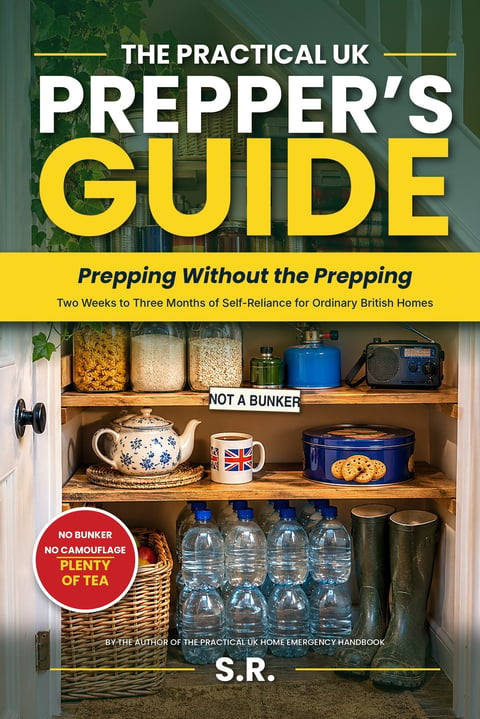
The Practical UK Prepper’s Guide: Prepping Without the Prepping
Two Weeks to Three Months of Self-Reliance for Ordinary British Homes (No Bunker, No Camouflage, Plenty of Tea)
Ready for more than a blackout? This one builds in plain English towards three months of genuine self-reliance for an ordinary British home — real shelves instead of a bunker, a normal weekly shop instead of panic buying, and a plan you can actually keep going. It starts from a fortnight of food, water and warmth: the level anyone can sensibly manage.
 Out now on Amazon
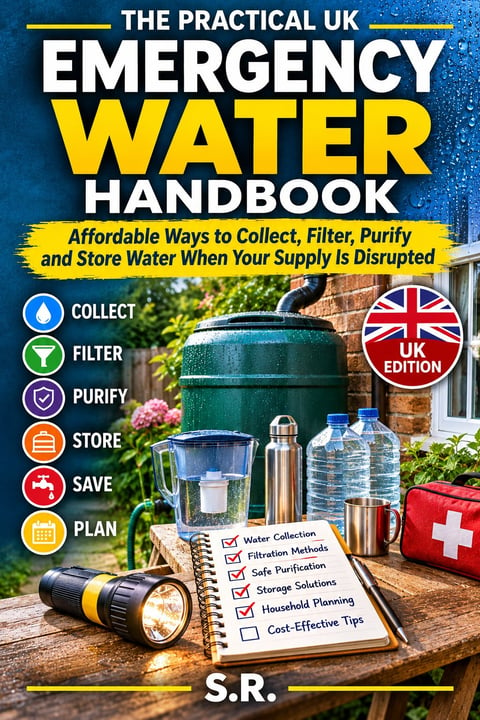
The Practical UK Emergency Water Handbook
Affordable Ways to Collect, Filter, Purify and Store Water When Your Supply Is Disrupted
When the taps run dry, a little planning goes a long way. How much water you actually need, storing it in a small flat, filtering, boiling and purification tablets, making every litre go twice as far — and what to do when the power fails too.
Buy on AmazonTake a look →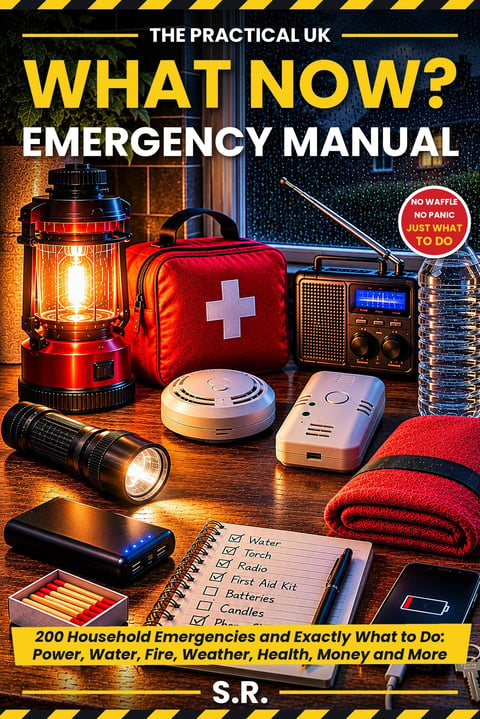 Out now on Amazon
What Now? The Practical UK Emergency Manual
200 Household Emergencies and Exactly What to Do: Power, Water, Fire, Weather, Health, Money and More
When it goes wrong, you need answers fast. Two hundred real household emergencies, each set out the same way: what's happening, do this now, then don't and call, and be ready next time. No stories. No waffle. Just what to do.
The find-it-fast companion to this handbook — large print available. See it in use on the UK emergency checklist.
Buy on AmazonTake a look →Large print
Every book in the Practical UK series is also available in a large print edition — clear, generous text for older readers and anyone who wants a paper copy they can find their way around in a hurry. Look for the large print option on each book’s Amazon page.
Free from the blog
Try the checklist before you buy the book
The power-cut chapter, free: the twelve things worth keeping at home, what your meter lights mean, who to call, and how to get ready this week without spending a penny.
Read the UK emergency checklistQuestions About The Handbook
Short, plain answers about what the book covers, what to do in a power cut or water outage, what belongs in a home emergency kit, and how to get the most out of it on an ordinary budget.
What is The Practical UK Home Emergency Handbook about?+
It is a plain-English, budget-first guide to preparing a British home for power cuts, water shortages, extreme weather and everyday emergencies. It covers what to keep at home, how to get through a blackout, a burst pipe or a water outage, how to prepare for storms, floods, snow and heat, and how to do all of it without spending a fortune.
Do I need to spend a lot of money to be prepared?+
No. The book starts with what you probably already own — torches, candles, tinned food, bottled water, a radio, first aid, paperwork — and works in tiers: the free things this week, the cheap things next month, and the rest over time whenever it suits. It is written specifically for ordinary British households on ordinary budgets.
Is this a survivalist or prepper book?+
No. There are no bunkers, no gas masks and no freeze-dried food for eighteen. It is a practical handbook for the events that actually happen in the UK — storms, power cuts, water outages, flooding, snow, heat and the everyday emergencies in between — with a dose of British humour.
What should I have at home for a power cut in the UK?+
Torches and spare batteries, a battery-powered or wind-up radio, charged power banks, a first aid kit, bottled water, tinned food you will actually eat, warm layers and blankets, and easy access to torch, keys, medication and important documents. The book explains how much of each, where to keep it and how to do it on a budget.
Read the free UK emergency checklist →How do I prepare for a water shortage or water outage?+
Store a reasonable amount of bottled water, know your supplier's emergency contact and its advice, fill clean containers or the bath if supply is at risk, and follow any boil notice exactly as stated. The book walks through quantities, storage and the things people forget — like pets, medication and a kettle that needs water.
Is it suitable for families, older relatives and people with pets?+
Yes. It covers children, older relatives, neighbours, medication and pets, with simple plans that survive contact with real life. Households with babies or medical needs will find the practical checklists especially useful.
Who is the book for?+
Anyone who has ever stood in a dark kitchen wondering what they were supposed to do. Renters, homeowners, families, single people, older readers and anyone who wants a sensible plan that does not cost a fortune.
What format is it available in, and where can I buy it?+
The Practical UK Home Emergency Handbook is available on Amazon UK in Kindle, paperback and large print editions. The large print edition uses clear, generous 16-point text and is a good choice for older readers or anyone with sight difficulties. The buy links for both the standard and the large print edition are on this page.
Which Practical UK books are available in large print?+
All four books in the Practical UK series — The Practical UK Home Emergency Handbook, The Practical UK Emergency Water Handbook, What Now? The Practical UK Emergency Manual and The Practical UK Prepper's Guide — are available in large print editions on Amazon UK, alongside their standard editions. Look for the large print option on each book's Amazon page.
What should I do first in a power cut?+
First, check whether the power cut is only in your home or affects the street — if neighbours' lights are out too, it is a network fault. Then turn off and unplug appliances that were running, leave the fridge and freezer closed, find a torch rather than lighting candles, and report the outage to your power network operator on 105. The book goes through each step in order, including keeping food safe and looking after anyone who relies on powered medical equipment.
How long can food stay in the fridge or freezer during a power cut?+
Keep the fridge and freezer doors closed and food stays safe for roughly four hours in a fridge and up to 24 hours in a full freezer (less if it is half empty). Eat fridge food that is still cold first, and in the freezer, anything that still has ice crystals or is still firm and very cold can usually be cooked rather than thrown away. The handbook explains exactly what to check and how to plan meals around it.
Is it safe to use candles during a power cut?+
It is far safer to use torches, head torches and battery or wind-up lanterns. Candles are the single most common cause of house fires during power cuts, so the book treats them as a last resort: never leave them unattended, keep them away from children, pets and curtains, and never take a candle into a room where you might fall asleep. It also covers carbon monoxide, which is a separate danger when a generator or camping stove is used indoors.
How do I find and turn off my water stopcock?+
Your stopcock is usually under the kitchen sink, in a cupboard near the front door, or in an understairs cupboard, and it is turned clockwise to close. Find it before you need it, make sure it actually turns, and tag it so everyone in the house knows where it is. The book explains this — along with the outside stop valve, how to drain pipes safely, and what to do if a pipe bursts and water is coming through the ceiling.
What is a Priority Services Register and does it apply to me?+
Water and power companies keep a Priority Services Register for customers who need extra help in an outage — for example people with medical needs, anyone who depends on powered equipment at home, older residents, and families with very young children. Registration is free; you contact your own supplier or network operator to join. The handbook, and its sister title The Practical UK Emergency Water Handbook, explain how to register and what you can expect.
Do I need a large print edition?+
There is a dedicated large print edition, printed with clear, generous 16-point text — useful for older readers, anyone with sight difficulties, and as a gift for parents or grandparents who want a paper copy they can quickly find their way around in a hurry. It contains the same content as the standard paperback.
How is this different from a prepper or survivalist manual?+
It is written for the emergencies that actually happen in Britain — storms, power cuts, water outages, flooding, snow and heat — and for households on ordinary budgets. There is no talk of bunkers, gas masks or weapons. This book is about being prepared enough to stay calm and keep your home going through the first few days. If you want to go further — towards two weeks or three months of self-reliance — its companion, The Practical UK Prepper's Guide: Prepping Without the Prepping, is the next step.
Can I read it on Kindle, and is there an audiobook?+
Yes, it is available on Kindle as well as in paperback and large print on Amazon UK. At present there is no audiobook version of this title. A Kindle copy is handy because it is searchable, but a paper copy kept in a kitchen drawer never needs charging during a power cut.
What should I keep in a home emergency kit in the UK?+
The essentials are torches and spare batteries, a battery or wind-up radio, charged power banks, a first aid kit, bottled water, tinned and ready-to-eat food you will actually eat, a tin opener, warm layers, medication, copies of key documents, and some cash. Add a phone charger, a pen and paper, and a note of your supplier and network operator numbers. The handbook sets out quantities for each household size and shows how to build it in affordable tiers.
Where can I find more Practical UK handbooks?+
The author has written two companion titles: The Practical UK Emergency Water Handbook — on collecting, filtering, purifying and storing water when the supply is disrupted — and What Now? The Practical UK Emergency Manual, which covers 200 household emergencies and exactly what to do, from power, water, fire and weather to health and money. Both are linked from this page and from the Buy Less Crap Books page.
This handbook is general guidance for household preparedness. In a genuine emergency, always follow the advice of your water supplier, power network operator, local authority and the emergency services.