
● Out Now on Amazon
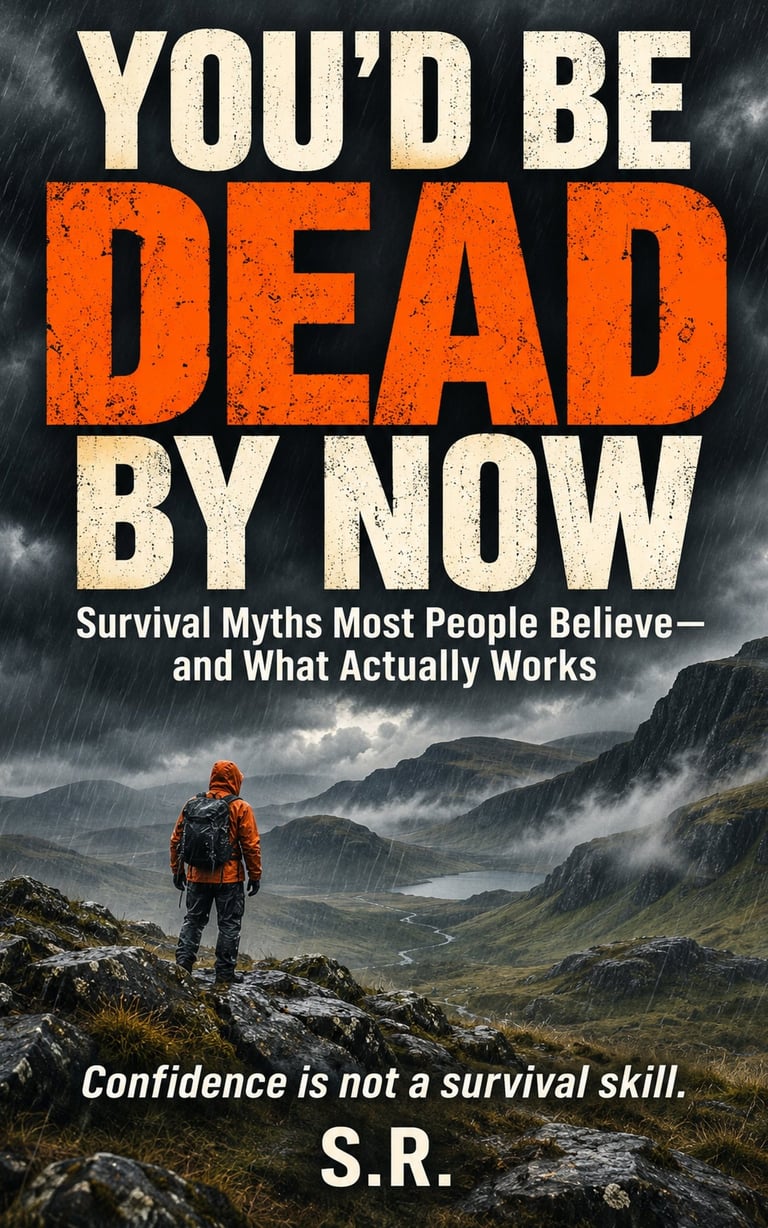
You’d Be Dead By Now
Survival Myths Most People Believe—and What Actually Works
By S.R.
You think you’d know what to do. You wouldn’t. The survival advice we all picked up from films, telly and the playground — most of it will get you hurt, or worse. This book tells you why, and what actually works.
Available now in paperback on Amazon UK, in standard and large print.
What Is This Book?
You’d Be Dead By Now takes the survival “facts” that most people believe — snake bites, urine, frostbite, moss, bears, cold water, water rationing — and shows, plainly, why they are wrong. Then it gives you what actually works, for when the phone is dead, the light is going, the weather has turned, nobody knows where you are, and you have no choice but to get yourself through it.
The Myths, And What To Do Instead
Most people believe at least half of these. Here is the short version — the book has the detail.
“Suck the venom out of a snake bite.”
Actually: It does not remove the venom. It adds infection risk and does nothing useful. Keep still, immobilise the limb, and call for help.
“Drink your own urine when the water runs out.”
Actually: Urine is mostly the waste your kidneys are trying to get rid of. Drinking it makes you more dehydrated.
“Rub frostbitten fingers to warm them.”
Actually: Rubbing frozen tissue damages it. Warm it gently and gradually instead.
“Follow the moss to find north.”
Actually: Moss grows in damp, shaded places. It knows nothing about north. A map and a phone know about north.
“Swim for the shore the moment you fall into cold water.”
Actually: Cold water shock makes you gasp and thrash. Float first, breathe, then decide.
“Run from a bear.”
Actually: You will not outrun it, and running triggers the chase. Slow down, back away, stay calm.
“Ration your water to make it last.”
Actually: Unless you have a fixed supply and a known rescue, rationing just speeds up how fast you dehydrate.
What’s In It
Fifteen chapters. Each one: the myth, the truth, the steps, a “When you have no choice” section and a ten-second summary.
The survival mindset
Your brain packs in before your body does. How to catch fear before it tips into panic, accept where you are fast, and train the will to keep going.
Cold, wet, wind and heat
How fit, sensible people slide into hypothermia, why several thin layers beat one big coat, and the quiet way heat does for you.
Water that wants you dead
Cold water shock, Float to Live, rip currents, tides, mud, flooded roads and thin ice — and why jumping in after someone so often ends with two bodies.
Shelter
The moves that matter in the opening ten minutes, making do with what's in your bag, and building something from nothing when you have to.
Fire
Rubbing two sticks is a last resort, not a plan. Start one with batteries, foil or a lens, find dry wood in pouring rain, and keep it alive till morning.
Water you can drink
Clear isn't clean. Where to look when there's no tap in sight, and how to make it safe with a can, a bottle or the sun.
Finding your way
No compass, no phone — just the sun and the stars. Plus the one decision that matters most: sit tight, or start walking?
Getting found
How to call for help anywhere on earth, which signals rescuers genuinely watch for, and what to do when a helicopter can't land.
Food when you're truly stuck
You won't starve in a week. Foraging is more likely to poison you than feed you — and here's what's genuinely safe if you're desperate.
First aid when help is hours away
Bleeding, broken bones, dirty wounds and infection — plus the home remedies that quietly make everything worse.
Animals
Cows, dogs, bears, big cats, snakes, ticks and stings: stand your ground, back away slowly, or leave well alone — and which is which.
Extreme places
Lightning strikes, desert and dry country, and wildfire — the rules that change completely when you leave green Britain behind.
Everyday survival
Choking, CPR, getting out of a sinking car or a burning house, a crowd crush, spotting a stroke or heart attack, and keeping yourself safe on the street.
Simple self-defence
Notice trouble early, de-escalate with your mouth, and learn escapes that work — the aim is to get away, never to win.
The 24-Hour Test
A safe, step-by-step challenge at home or in the garden that shows you honestly how ready you actually are.
Built To Be Used Under Pressure
Survival books assume you already know the kit. This one assumes your hands are cold and your brain has gone blank.
The myth
The advice you have probably heard, in the words people actually use.
The truth
Why it is wrong, and what happens to people who follow it.
Step by step
Clear actions in order — first, second, third.
When you have no choice
The plan for when it has gone wrong and help is hours away.
Ten-second summary
The bit you can still remember when everything else has gone.
Diagrams & flowcharts
Plain black-and-white visuals and yes/no questions to the right move.
And a dry sense of humour throughout. Not because emergencies are funny, but because people cope better when they can still breathe.
Because you’d be surprised what you can do when you have no choice.
Who It’s For
- Hillwalkers, campers and wild swimmers who want to know what to do when the plan goes wrong
- Travellers heading somewhere with no easy help nearby
- People who drive remote roads in bad weather
- Parents whose teenagers have started going off the beaten track
- Anyone who has ever wondered "would I actually know what to do?" — and would like a straight answer
- Readers of the Practical UK handbooks who want to step outside the front door
Get You’d Be Dead By Now
Out now in paperback on Amazon UK — standard and large print. Read it before you need it.
Questions About The Book
When is You'd Be Dead By Now out?+
It is out now on Amazon UK as a paperback, in a standard and a large print edition. Both buy links are here on this page and on the Books By S.R. shelf.
Is You'd Be Dead By Now a prepper or survivalist book?+
No. There are no bunkers, no stockpiling and no camouflage. It is a myth-busting practical book about what to do when you are cold, wet, lost, injured or in danger — and why much of the advice people repeat makes things worse.
Who is S.R.?+
S.R. is the author name used by Steve at Buy Less Crap for his non-fiction books, including The Practical UK Home Emergency Handbook, The Practical UK Emergency Water Handbook, What Now? The Practical UK Emergency Manual and The Practical UK Prepper's Guide.
Does it cover everyday emergencies as well as wilderness ones?+
Yes. As well as cold, water, shelter, fire, navigation, getting found, food, animals, lightning, desert and wildfire, it covers choking, CPR, escaping a sinking car or a house fire, crowd crushes, spotting a stroke or heart attack, and simple self-defence.
Is this for beginners?+
Yes. It assumes no kit, no training and no memory of anything you once read. Every chapter explains the myth, the truth, the steps to take and what to do when there is no choice left.
Is it suitable as a gift?+
It suits anyone who walks, camps, travels or spends time outdoors — or anyone who has ever confidently told a bad survival fact at dinner and would now like to know better. It comes in the same plain, dry-humoured style as the Practical UK series.
Is the advice in the book a substitute for training?+
No. It is practical general guidance. For anything serious, take a proper first-aid or outdoor course, follow the guidance of emergency services and rescue teams, and never put yourself at risk to test something.
Where can I read more about it?+
There is a longer post on the Buy Less Crap blog covering the survival myths the book takes apart, what is inside each chapter and why it is written the way it is.
This book is general guidance, not a substitute for training. In a real emergency call 999 in the UK or the emergency number where you are, and follow the guidance of the emergency services, coastguard and mountain rescue.
Back to top