
New book · Out now
You’d Be Dead By Now
Survival Myths Most People Believe—and What Actually Works
By S.R. · out now on Amazon
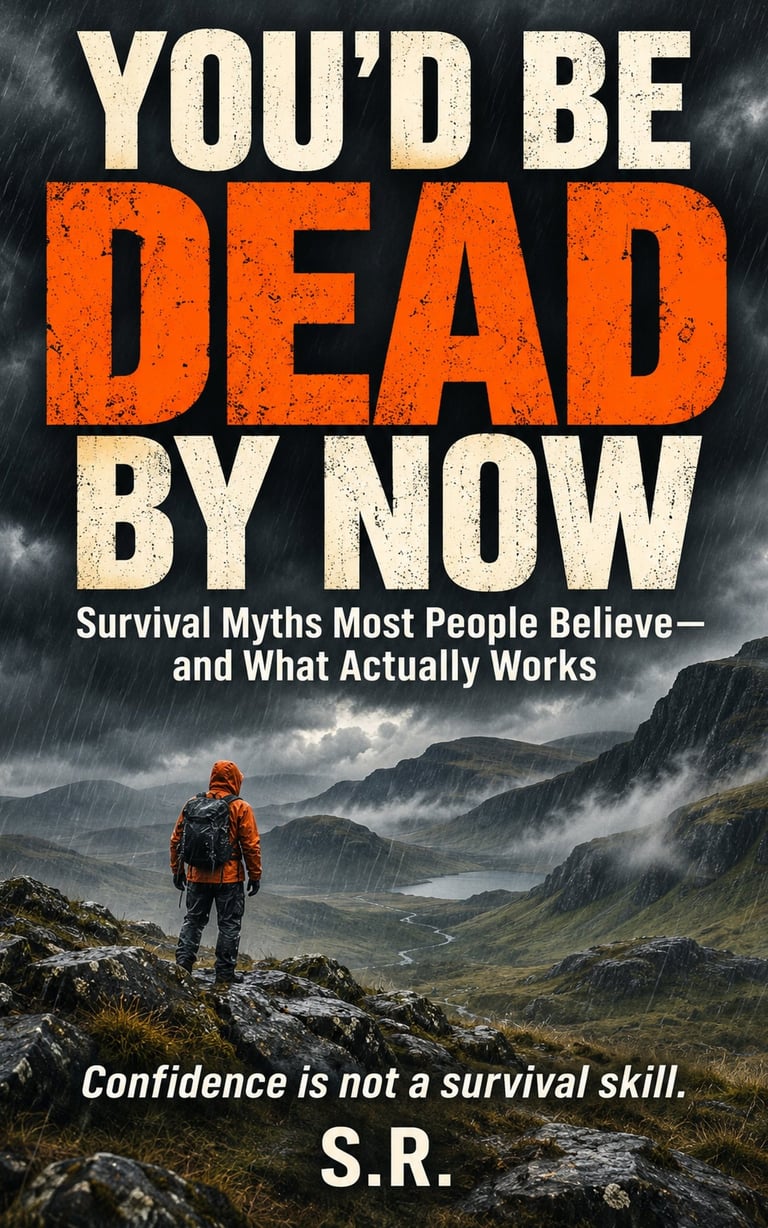
You think you’d know what to do. You wouldn’t.
You’d Be Dead By Now is a book about the survival “facts” most of us pick up from films, TV and the school playground — and about why almost all of them are wrong. It is written for the moment your phone is dead, the light is going, the weather has turned, nobody knows where you are, and you have no choice but to get yourself through it.
Each chapter takes one widely believed piece of advice, tells you plainly why it gets people hurt, and then gives you the version that actually works — plus a “When you have no choice” section for when everything has already gone wrong.
The survival myths this book takes apart
Most people believe at least half of these. Every one of them can leave you hurt, or worse. The book covers far more than the seven below — but these are the ones people repeat most often.
Suck the venom out of a snake bite.
Actually: Cutting or sucking a snake bite does not remove the venom and it is a great way to give the casualty an infection or a nasty mouth wound. Keep the person still and calm, immobilise the limb at or slightly below heart level, remove rings and watches, and get emergency help fast.
Drink your own urine when the water runs out.
Actually: Urine is mostly water plus the waste your kidneys were getting rid of. Drinking it makes dehydration worse, not better. Find or make clean water, or follow the safe water chapter — nothing else.
Rub frostbitten fingers to warm them.
Actually: Rubbing frozen tissue does mechanical damage and makes the injury worse. Warm the area gently and gradually in water that is comfortably warm — not hot — and never against a fire or radiator.
Follow the moss to find north.
Actually: Moss grows where there is moisture and shade, which has nothing to do with which way is north. In Britain you are rarely more than a few miles from a road; a map, a whistle and a charged phone are what actually get you home.
Swim for the shore the moment you fall into cold water.
Actually: The first sixty seconds are the danger. Cold water shock makes you gasp and thrash — and that is what kills people. Float to live on your back, control your breathing, then decide whether to swim. Much of the UK coast also has rip currents, and the shore is often not the nearest safe exit.
Run from a bear.
Actually: Running triggers chase instinct and you will not outrun a bear. Do not run. Make yourself big, talk calmly, back away slowly, and know what to do for black bears, brown bears and a bear with cubs — because the right answer is not the same for each.
Ration your water to make it last.
Actually: Unless you are stranded with a fixed supply and a known rescue date, rationing water just speeds up dehydration. Drink what you have, then find more. Thirst is a late signal; by the time you feel it you are already down.
What’s inside the book
Fifteen chapters, from the moment your brain starts lying to you through to getting found and getting out. Simple black-and-white diagrams and yes/no flowcharts let you find the right action in seconds — even when you can’t think straight.
01. The survival mindset
Why your brain is the first thing to fail, how to stop fear turning into panic, how to accept the situation quickly, and why the will to live is a skill you can train.
02. Cold, wet, wind and heat
How hypothermia creeps up on fit, sensible people, why several thin layers beat one big coat, and how heat kills quietly.
03. Water that wants you dead
Cold water shock, the Float to Live technique, rip currents, tides, mud, flooded roads, thin ice, and why going in after someone kills so many rescuers.
04. Shelter
What to do in the first ten minutes, using what you carry and building from scratch when you must.
05. Fire
Why rubbing two sticks is the last resort, fire without matches using batteries, foil and lenses, finding dry wood in the wet, and keeping a fire going all night.
06. Water you can drink
Why clear isn't clean, finding water when there is none, and making it safe with a can, a bottle or the sun.
07. Finding your way
Without a compass, without a phone, by the sun and the stars, plus the big decision: stay or move?
08. Getting found
Calling for help anywhere in the world, signals rescuers actually recognise, and what to do when the helicopter comes.
09. Food when you're truly stuck
Why you won't starve this week, why foraging will probably poison you, and what's safe to eat when you have no choice.
10. First aid when help is hours away
Serious bleeding, breaks, wounds, infection and the myths that make things worse.
11. Animals
Cows, dogs, bears, big cats, snakes, ticks and stings, and which ones to fight, which to back away from, and which to leave well alone.
12. Extreme places
Lightning, desert and dry country, and wildfire.
13. Everyday survival
Choking, CPR, escaping a sinking car or a house fire, surviving a crowd crush, spotting a stroke or heart attack, and staying safe on the street.
14. Simple self-defence
Awareness, talking someone down, and easy-to-learn escapes so you can get away, not win a fight.
15. The 24-Hour Test
A safe, step-by-step challenge to try at home or in the garden to find out how ready you really are.
What each chapter gives you
The myth
The piece of advice you have probably heard, in the words people actually use.
The truth
Why it is wrong, and what happens to people who follow it.
Step by step
Clear actions in order — what to do first, second and third.
When you have no choice
The plan for when everything has gone wrong and help is hours away.
Ten-second summary
The version you can remember under stress, even when your head has gone blank.
Diagrams & flowcharts
Plain black-and-white diagrams and yes/no flowcharts to find the right move fast.
Why it is written like this
Survival books tend to assume you have already bought the kit and read the first four chapters. Life does not work that way. The dangerous moment arrives in the middle of something else — a walk that ran long, a stream crossing that looked fine, a night out where the taxi never came — and what you will actually use is what you can recall under pressure.
So this book starts from what people believe rather than what they should know. It debunks the myths first, because a wrong idea is more dangerous than no idea. Then it gives you the right steps, short enough to use when your hands are cold and your brain is not at its best.
It also has a dry sense of humour. Not because emergencies are funny, but because people cope better when they can breathe.
Confidence is not a survival skill. Knowing what actually works is.
Out now
You’d Be Dead By Now
Available now in paperback on Amazon UK, in standard and large print. The book’s page has the full cover and chapter list, and it sits on the Books By S.R. shelf.
More from the same shelf
If it is household emergencies rather than wilderness ones you are worried about, the Practical UK handbooks are for the power cut, the water outage and the storm.
Household
The Practical UK Home Emergency Handbook
Power cuts, water shortages, storms, floods and everyday emergencies.
Water
The Practical UK Emergency Water Handbook
Collecting, filtering, purifying and storing water when the supply is disrupted.
Questions about the book
What is You'd Be Dead By Now about?+
You'd Be Dead By Now: Survival Myths Most People Believe—and What Actually Works is a plain-English survival book by S.R. It takes the survival 'facts' most people have picked up from films, TV and the school playground — sucking snake venom, drinking urine, rubbing frostbite, following moss, swimming for shore in cold water, running from a bear, rationing water — explains why they are wrong, and then gives you the approach that actually works.
Is You'd Be Dead By Now available yet?+
Yes. You'd Be Dead By Now is out now on Amazon UK as a paperback, in a standard and a large print edition. Both buy links are on the book's page on this site, on the Books By S.R. shelf, and directly on Amazon.
Who is S.R.?+
S.R. is the author name used by Steve at Buy Less Crap for his non-fiction books, including The Practical UK Home Emergency Handbook, The Practical UK Emergency Water Handbook, What Now? The Practical UK Emergency Manual and The Practical UK Prepper's Guide. Unlike those household-preparedness titles, You'd Be Dead By Now is about being outside, in the weather, away from help.
Who is it for?+
Anyone who hikes, camps, drives remote roads, travels, fishes, sails or otherwise spends time away from easy help — and anyone who simply wants to know they would cope if things went wrong. It is written for ordinary adults, not for survival experts, and it assumes no fancy kit.
Is it a prepper or survivalist book?+
No bunkers, no gas masks and no camouflage. It is a myth-busting, practical book about what to do when you are cold, wet, lost, injured or in danger — and about why most of the advice people repeat makes things worse. It has the same plain-speaking, dry sense of humour as the Practical UK handbooks.
What does each chapter include?+
Every chapter follows the same structure: the myth, the truth, clear step-by-step actions, a 'When you have no choice' section for when everything has gone wrong, and a quick ten-second summary to remember. Simple black-and-white diagrams and yes/no flowcharts help you find the right action in seconds, even under stress.
Does it cover everyday emergencies, not just wilderness ones?+
Yes. As well as outdoor survival — cold, water, shelter, fire, finding your way, getting found, food, animals, lightning, desert and wildfire — it covers everyday situations such as choking, CPR, escaping a sinking car or a house fire, crowd crushes, spotting a stroke or heart attack, and simple self-defence.
What should you actually do if you fall into cold water?+
Float on your back and control your breathing first. The danger in the first minute is cold water shock, which makes you gasp and thrash; fighting to swim straight away is what puts people under. Once the shock passes and you can breathe, call for help or work out the nearest safe way out — which is not always the shore you can see. The book covers cold water shock, rip currents, tides and rescuing someone else without becoming the second casualty.
Is banning water rationing correct — shouldn't you conserve what you have?+
Rationing only makes sense in a very specific situation: a fixed supply, a known length of wait and someone on the way. In almost every other scenario, drinking what you have and then finding more beats sipping a tiny amount while dehydration sets in. The book explains when rationing does make sense and when it does not.
This post is general information about a book, not instruction for a specific emergency. In a real emergency call 999 in the UK, or the emergency number where you are. Always follow the guidance of the emergency services, the coastguard or mountain rescue. Going into cold water, near a river or on a mountain can kill, and no book replaces training or common sense.