I write about index funds, ISAs and buying less crap. So a book about power cuts needs a bit of explaining. Sit down, put the kettle on while you still can, and I'll tell you where this one came from.
It came from a Tuesday in March. Twenty-past-nine in the evening. I was in the kitchen, halfway through a cup of tea I would never finish, when everything went off at once — the lights, the telly, the fridge's gentle humming, the little green lights on the router that I had never appreciated until exactly that moment.
For a few seconds you just stand there. Experienced people, I have since learned, do not stand there. Experienced people have a plan. I had a dark kitchen, a phone on eight percent, and the vague, dusty memory of a torch somewhere in the shed.
The Torch In The Shed
The torch was in the shed. It had been in the shed since the Jubilee. On inspection it was, and I say this with some affection, entirely decorative. No batteries. Not the right shape of batteries, in fact. The shed, for its part, had one candle floating around somewhere near the paint tins, and no matches, unless you count the damp, tragic-looking box that had been sitting there long enough to be considered an heirloom.
Next door, the neighbour's generator started up with the smug, well-oiled confidence of a man who had prepared for this. Nobody said anything. Nobody needed to. The generator said it all.
Inside our house, the freezer hummed a few sad farewells. The heating went quiet. My wife found a birthday candle, which burned with the dignity of a thing that knows it is out of its depth. And I sat in the dark thinking the most expensive thought I've had in years: why on earth didn't I sort this out before?
Nobody died. Nobody had to be rescued. It was, by any sensible measure, a small inconvenience. But it was a small inconvenience that would have been a story, rather than a crisis, if I had spent an hour — one hour, at any point in the previous ten years — doing the sensible thing.
Why That Became A Book
That night I started making a list on my phone, in the glow of eight percent of battery, of all the things I wished I'd known. Where the stopcock is. Where to find the water supplier's phone number. What actually happens to your freezer. Whether it's safe to use the gas hob (it is, generally, but don't take that as gospel — check your own appliance guidance). Which of the things in the cupboard were the emergency things and which were the things I'd bought in a mild panic about a different emergency entirely.
What surprised me was how little of it was about buying anything. Most of what I needed was already in the house. Most of what I didn't know was free to learn. The gap between "caught out" and "sorted" was almost entirely knowledge, not money — which is, if you've read anything else on this website, exactly the thing I bang on about all the time with investing, only with more candles.
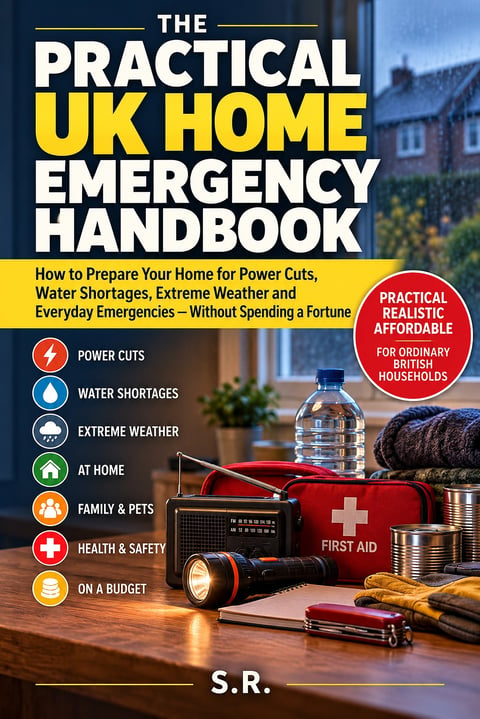
So I wrote the handbook I wanted that evening. It became The Practical UK Home Emergency Handbook: How to Prepare Your Home for Power Cuts, Water Shortages, Extreme Weather and Everyday Emergencies — Without Spending a Fortune.
It's An Emergency Handbook With A Difference
Most preparedness books are written by people who already own a generator and a north-facing larder. This one is written by a man whose torch was in the shed. It tells the story first — the dark kitchen, the daft torch, the smug generator next door — and then gives you the handbook the story needed.
It is funny about the small humiliations. The candles with no matches. The batteries from 2019. The torch kept in the one place it will never be needed. The neighbour who will absolutely tell you about his generator, and whose generator you will absolutely want by Tuesday morning.
And it is serious about the things that matter. Where to find the stopcock (and why you should find it before you need it). How long food is safe when the power goes. What to do when the taps run dry. Which number to call when the lights come back on for the rest of the street and not for you.
That's the difference. It doesn't pretend being caught out is glamorous, and it doesn't shout at you to stay calm, which — let's be honest — has never calmed anybody down in the history of the world.
What's Actually Inside
The book covers the things that actually happen in this country. Not a global catastrophe, not a scenario where you're living off the land. Power cuts, water shortages, storms, floods, snow, ice, heatwaves, and the everyday emergencies in between — burst pipes, boiler breakdowns, the Thursday evening when everything picks its moment.
On power cuts: torches and batteries (and the fact that the torch in the shed is not a plan), candles without setting the house on fire, keeping the freezer cold and knowing what to throw out afterwards, what to do about the boiler and the router, and why the meter cupboard is not a disaster zone and you should possibly visit it more than once a decade.
On water shortages: how much water actually matters, what to store and where, how to fill containers sensibly, how to handle a boil notice, and the bath you never thought would earn its keep.
On extreme weather: storms, floods, snow, ice and heatwaves — what to do before, during and after, where the grit bin is, and the difference between a bit of wind and the kind of wind that rearranges your garden.
On the home itself: the kitchen cupboard that was secretly an emergency kit all along, documents, keys, phones and charging, heating alternatives, and the flickering fuse box that has always flickered and that you have always ignored.
On family: children, older relatives, neighbours, medication, and the dog who eats anything. Simple plans that survive contact with real life, which is the only test that matters.
On health and safety: first aid basics, smoke and carbon monoxide alarms, food safety in a blackout, and not doing anything heroic in flip-flops.
And on money, throughout: honest tiers so you can do the free things this week, the cheap things next month and the rest over time whenever it suits you.
It Doesn't Cost A Fortune (That's The Other Point)
The subtitle says "without spending a fortune", and I mean it, because I'm the man who spent an evening in the dark working out that most of his problems could have been solved with about a tenner.
Tier one is free. Find the torch. Find the batteries. Write down the water supplier and the power network operator's numbers. Locate the stopcock. Fill a couple of bottles with water and put them somewhere sensible. Make sure the smoke alarm works. That's this week, this afternoon, for nothing.
Tier two is about a tenner. A battery radio. A spare power bank. Tinned food you will actually eat. A cheap head torch so both hands stay free — a small thing I now consider a design miracle.
Tier three is over time. The sensible extras at your own pace. A small cooler. A camping stove used outdoors only. Copies of key documents. None of it urgent, all of it useful, and if you go at your own pace you'll actually finish it instead of buying a load of things in a panic and never looking at them again.
I've written about buying less crap for a long time, and this is the same idea wearing a slightly different hat. Preparedness isn't stuff. Most of it is knowing where things are and what to do next. The rest is a torch that works, and a plan that doesn't need you to be a survivalist.
Five Things That Surprised Me While Writing It
First, how much of it I didn't know. I'm 66. I have owned a house for decades. I did not know where my stopcock was until I wrote a book about it, which is a sentence I'm not proud to put in print.
Second, how many people I spoke to had a power-cut story. Once you start asking, everyone has one. The one where the freezer gave in. The one where the boiler woke up six hours later and made a noise like a kettle having a realisation. The one where the neighbour's generator became a small diplomatic incident.
Third, how cheap a decent emergency kit actually is if you buy it slowly and boringly rather than in a panic.
Fourth, that most advice people want is not about equipment. It's about sequence. What do I do first. What can wait. What should I not do. Sequence is free, and it's the bit that stops you panicking.
Fifth — and this one is the heart of the whole thing — that a bit of preparation is strangely calming. Not because you expect disaster. Because the small dread of "I really should sort that out" that lives quietly at the back of the head goes away. That's a better return than most things I've bought.
Seven Things You Can Do Today, Before You Buy The Book
None of these cost anything, and all of them are in the handbook in much more detail. Consider this the free sample.
One: find your stopcock. It's usually under the kitchen sink or near where the water comes into the house. Find it now, so you're not searching during a flood.
Two: check the torch. Not where it should be — where it actually is. Then check the batteries. Then put both somewhere you'll find them in the dark.
Three: write down your water supplier and your power network operator's emergency numbers on a piece of paper and stick it inside a cupboard door. Paper works when the internet doesn't.
Four: fill two bottles with water and put them somewhere sensible. That's a start. You can build from there.
Five: press the test button on your smoke alarm. You know you haven't done it in a while.
Six: have a conversation over a cup of tea about what happens if the power's out at night. Where's the torch. Who knows where the stopcock is. Who feeds the dog. Ten minutes, one conversation, genuinely useful.
Seven: think about food in the fridge and freezer. Know which drawer you'd start with if the power didn't come back, and don't open the freezer door to "check" — that's the whole trick of keeping it cold.
Who It's For
Renters, homeowners, families, people on their own, older readers, and anyone who has ever stood in a dark kitchen wondering what they were supposed to do. It's also a genuinely useful gift for a parent, a grandparent, a grown-up child who has just moved into their first flat, or a neighbour who looks after everyone else and never looks after themselves.
It isn't for people who already have a generator, a larder and a plan laminated to the back of the utility room door. Those people will find it charming but slightly beneath them. Everyone else will find it a relief.
The Honest Bit
I'm not an emergency planner. I'm not a survival expert. I'm a bloke with a mortgage who got caught out and decided to do something about it, and then checked everything with the people who actually know — the suppliers, the network operators, the published guidance — so that the funny bits stay funny and the serious bits stay correct.
In a real emergency, always follow the advice of your water supplier, your power network operator, your local authority and the emergency services. The book says this too, in plain writing, because it matters more than any torch.
Where To Buy It
It's out now on Amazon UK, and there's a link at the top and bottom of this post, plus the book has its own page here on the site at buylesscrap.co.uk/uk-home-emergency-handbook.
It's the first book I've written that might actually save you money rather than just making you laugh. Though it does both, on purpose. Serious where it matters, funny where the situation allows.
Prepared is not paranoid. Prepared is cheaper than being caught out. And the torch in the shed is not a plan.
Invest. Wait. Repeat. And keep a torch somewhere you can actually find it.
As always, this is a book I wrote and I'm recommending, and the Amazon links are ordinary links. Nothing here is financial advice.