Let me tell you about something I did last year that surprised me. I'd been tracking every pound I spent for a month — something I'd recommended others do but never done properly myself. What I found wasn't a single big expense or an obvious waste. It was dozens of tiny purchases that, individually, meant nothing: an upgraded delivery, a 'recommended for you' gadget, a book I never read, a t-shirt I wore once. Totalled up, they came to roughly £370. For things I could barely remember buying.
What bothered me wasn't the money. It was the realisation that I hadn't made conscious decisions about most of those purchases. Something else had made them — some automatic, unexamined impulse that acted before I'd even registered what was happening. I'd been spending money without my brain's permission. When I started reading about what was actually going on neurologically, what I found explained a lot.
Here's the neuroscience, as best as a 66-year-old non-scientist can explain it. When you anticipate buying something — when you see it, want it, click 'add to basket' — your brain releases dopamine, a neurotransmitter that makes you feel anticipation and pleasure. This is the same chemical pathway involved in eating, gambling, and other rewarding activities. The crucial finding, documented by neuroscientist Kent Berridge, is something called the 'wanting-liking gap': the dopamine peak happens during the anticipation of buying, not after you own the thing. Once the purchase is complete and the package arrives, the wanting resolves, and the liking system takes over — and for impulse purchases, the liking is frequently low.
This is why the third coffee gadget feels essential in the moment and pointless two days later. You didn't want the gadget. You wanted the wanting of the gadget. The anticipation was the point. The purchase was just how the brain resolved the tension. The gadget itself was collateral damage.
The modern digital economy has been engineered to exploit this mechanism with unnerving precision. One-click checkout removes the friction between impulse and purchase. Personalised recommendations create artificial desire for things you didn't know existed ten seconds ago. Flash sales and countdown timers manufacture urgency. Abandoned basket emails chase you across the internet. Every element of the online shopping experience has been optimised to trigger dopamine release at precisely the right moment to override whatever rational, deliberative part of your brain might otherwise say 'do I actually need this?'
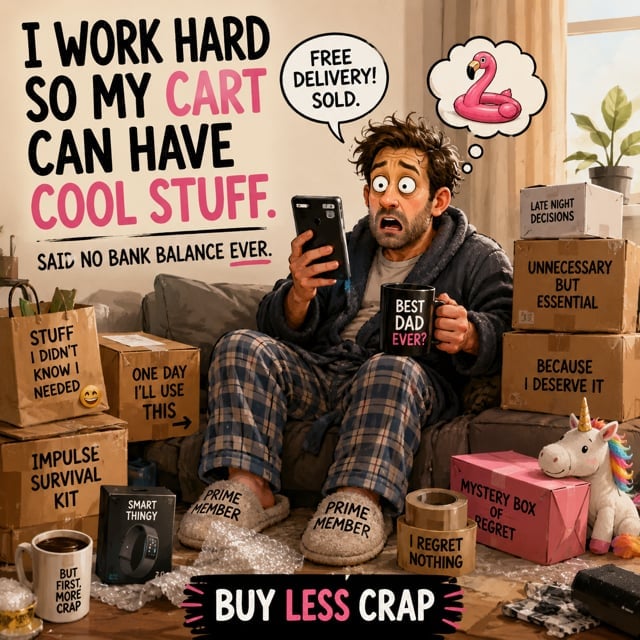
In 2025, Americans spent over $1.4 trillion on online shopping. That's not because people suddenly needed $1.4 trillion worth of new things. It's because the machinery of digital commerce has become extraordinarily good at converting attention into desire into purchase, at scale, continuously, while you're sitting on the sofa at 10pm wondering how another package ended up on its way.
I should be clear: most people who overspend online don't have a shopping addiction in the clinical sense. Compulsive buying disorder — oniomania — is a real condition, but it affects a relatively small percentage of people. What most of us experience is something milder but still costly: a habitual loop, triggered by boredom or stress or simply the presence of a phone in our hand, that results in purchases we wouldn't make if we paused for 30 seconds. We're not addicted. We're just not paying attention.
So what actually works to break the cycle? For me, it wasn't willpower. Willpower is a finite resource and the dopamine economy is a 24/7 operation. What worked were environmental changes that made the loop harder to enter in the first place. Here's what I did.
I removed shopping apps from my phone. Not out of heroic discipline — out of the opposite. I don't trust myself to resist the notifications, so I removed the notifications. If I genuinely need something, I can go to the website on my laptop. The extra friction is the point. Most of the time, the impulse passes before I get around to it.
I installed the 24-hour rule for anything over about £30 that isn't a genuine need. If I still want it tomorrow, fine. The research on this is clear: the dopamine spike fades quickly. What feels urgent at 9pm often feels forgettable the next morning. The 24-hour rule doesn't require you to deny yourself anything. It just requires you to confirm that you actually want it after the initial dopamine burst has passed. In my experience, about two-thirds of impulse purchases don't survive the night.
I stopped browsing as entertainment. This was the big one. I realised I'd been treating online shopping the way people treat window shopping — as a leisure activity. Scroll, discover, desire, and then either buy or feel the pang of not buying. Both outcomes are draining. Now I go online when I need something specific, buy it, and close the tab. No browsing. No 'discover'. No 'recommended for you'. The algorithm doesn't get a chance to manufacture desire.
The result of these changes, over the course of a year, was that my non-essential spending dropped by roughly 20% without any feeling of deprivation. I didn't go without anything I genuinely wanted. I just stopped buying the things I didn't actually want — the things the dopamine was wanting for me, while my rational brain sat in the passenger seat.
This isn't about never buying anything enjoyable again. Life is for living. The coffee you genuinely savour, the book you actually read, the meal out with people you love — that's what money is for. This is about the purchases that don't bring lasting satisfaction. The ones made by your dopamine system, not by you. Recognising the difference between what you want and what your brain temporarily wants has been one of the most financially valuable distinctions I've ever learned.
For educational purposes only. Nothing here is financial advice. The neuroscience described is simplified from published research — I'm not a scientist. Spending decisions are personal. What worked for me may not work for you.