── The Napkin Test ──
I've got 45 blog posts on this website. More than 30 buy posts. Pages about getting started, pages about mistakes I've made, pages about the psychology of spending, pages about the specific ETFs I own and why I own them and why I bought more of them on a random Tuesday afternoon. If you printed the whole thing out, it would be — I don't know — a lot of pages. A small forest. Probably enough to fill a decent-sized recycling bin.
But here's the thing: you don't need most of it. Don't get me wrong — I'm glad I wrote it, I'm glad people read it, I'm glad the detail exists for anyone who wants to go deep. But if you just want to know what I actually do — the system, the philosophy, the whole thing — it fits on the back of a napkin. It's three rules. Maybe four if you count the disclaimer. It's so simple it almost sounds stupid when you say it out loud. And that's exactly the point.

This post is the napkin. This is everything I believe about money, investing, and life — boiled down to its absolute essence. No fluff. No filler. No 'in part three of this seven-part series.' Just what I do, why I do it, and why it works. Read it once. Then go do it. That's the whole assignment.
── Rule One: Buy Less Crap ──
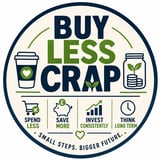
This is not a metaphor. This is not a brand slogan that I came up with because it sounded catchy. This is the actual, literal, day-to-day rule that governs my relationship with money: buy less stuff I don't need.
Every pound I don't spend on crap is a pound that can be invested. Every pound invested is a pound that compounds. Every pound that compounds is a pound that buys me freedom — freedom from stress, freedom from the 9-to-5, freedom from lying awake at 3am wondering if I'll have enough. The maths isn't complicated. The execution is the hard part. The execution is always the hard part.
So what does 'Buy Less Crap' actually look like in practice? It looks like the 24-hour rule for anything non-essential. It looks like deleting shopping apps from my phone so I can't impulse-buy at 11pm when I'm bored. It looks like asking myself — before every purchase — 'Will this actually make my life better, or am I just filling a hole that can't be filled with stuff?' It looks like auditing my subscriptions once a year and cancelling the ones I forgot about. It looks like cooking at home most nights because a £3 meal deal beats a £15 takeaway that I won't remember eating next week.
It does NOT look like never enjoying anything. It does NOT look like living on baked beans in a cold flat. It does NOT look like guilt-tripping myself every time I buy something nice. The point isn't to spend nothing. The point is to spend intentionally. To spend on things that actually make me happy — a good meal with friends, a weekend away, a book I'll actually read — and ruthlessly cut everything else. The gap between what I earn and what I spend is where all the magic happens. Widen the gap. That's Rule One.
── Rule Two: Invest The Difference ──
Right. You've bought less crap. You've got money left over at the end of the month. Now what? You invest it. Not next month. Not when you've 'done more research.' Not when the market's 'calmer.' Now. Today. This week. Into a broad, low-cost index fund. Automatically. Every single month. Without fail.
Here's what I buy. This is not a recommendation. This is not advice. This is literally just what's in my SIPP and ISA right now:
VWRP — the Vanguard FTSE All-World UCITS ETF (Accumulating). 3,700+ companies across nearly 50 countries. 0.22% annual fee. This is my default. This is my happy place. This is the fund I buy when I don't have a specific conviction about anything — when I just want to own the global economy and let compounding do its work. If I could only own one ETF for the rest of my life, this would be it. Actually no — I'd probably want two. Which brings me to...
VUAG — the Vanguard S&P 500 UCITS ETF (Accumulating). 500 of America's largest companies. 0.07% annual fee. Seven basis points. Seven pounds a year for every £10,000 invested. Less than a meal deal. For that, you get Apple, Microsoft, Nvidia, Amazon, Meta, Alphabet, Berkshire Hathaway, and 493 others. The S&P 500 has been the greatest wealth-creation machine in human history for the last century. Will the next century look the same? Nobody knows. But buying it alongside VWRP — tilting the portfolio toward US large caps while still owning the rest of the world — feels right to me. Has felt right for years. Keeps feeling right every time I add more.
And then there are the conviction picks. The individual stocks. Apple. Amazon. Meta. Reddit. Palantir. Johnson & Johnson. The things I've written about in the buy posts. But here's the thing about the conviction picks — and I want to be crystal clear about this — they are small. Collectively. Deliberately. The core of my portfolio is VWRP and VUAG. The individual stocks are seasoning, not the main course. They keep things interesting. They let me express views about specific companies I believe in. They scratch the 'I want to be a clever stock picker' itch without letting that itch destroy my financial future. If every single individual stock I owned went to zero tomorrow — every single one — I'd be annoyed. I'd be very annoyed. But I'd be fine. The index funds would carry on. The compounding would continue. The plan would still work.
That's the portfolio. Two ETFs. A handful of conviction stocks. Regular top-ups. Nothing cleverer than that. Nothing more complicated than that. The entire thing takes about 10 minutes a month to manage. If you're spending more than 10 minutes a month managing your portfolio, you're probably doing something wrong — or at least something unnecessarily complicated.
── Rule Three: Give It Time ──
This is the one that separates the people who actually build wealth from the people who just talk about it. You have to wait. You have to keep adding money. You have to not sell when the market drops 20% or 30% or 50%. You have to sit on your hands when every headline is screaming 'CRISIS' and every instinct in your body is telling you to run. You have to do nothing. For years. Sometimes for decades.
And here's the cruel truth that nobody tells you: the first decade feels like nothing is happening. You put away £300 a month. You watch the balance creep up. £10,000. £20,000. £30,000. It feels... fine. It feels like a sensible savings account with slightly better returns. It does not feel like the eighth wonder of the world. It does not feel like magic. It feels like a spreadsheet that updates once a month and never quite looks as impressive as you hoped.
Then the second decade kicks in. And suddenly the numbers start doing things that don't make intuitive sense. The growth on your contributions is now being matched by the growth on your growth. The curve that looked flat for 10 years starts bending upward. The £300 a month you're still adding is now competing with the £800 a month the portfolio is generating on its own. And somewhere around year 15 or 16 or 17 — the exact year varies, but it always happens — the portfolio starts earning more each year than you're putting in. That's the crossover point. That's when you stop being an investor who saves and start being an investor whose investments do the saving for you.
None of this requires you to be smart. None of it requires you to pick winning stocks or time the market correctly or predict which way interest rates are going. It requires precisely two things: consistency and patience. Buy regularly. Don't sell. Wait. That's it. That's the whole secret. And the reason most people don't do it isn't that they don't understand the maths — it's that waiting is hard. Doing nothing is hard. Trusting a process that doesn't provide daily feedback is hard. But it works. It has always worked. It will probably always work — though nobody can guarantee that, and anyone who does is selling something.
── The Automation System ──
Right. You know the three rules. But knowing rules and following rules are two different things. Most people know they should spend less and invest more. Most people don't do it. The gap between knowing and doing is where most financial plans die. The bridge across that gap is automation.
Here's my system. It takes about 90 minutes to set up and then runs itself for years:
Payday. The money hits my current account.
The same day — automatically — a standing order fires off a chunk to my Stocks and Shares ISA. Another chunk to my SIPP. Another chunk to a high-interest savings account for the emergency fund (which is already fully funded, but I like to keep it topped up).
Inside the ISA and the SIPP, auto-invest rules buy VWRP and VUAG at my chosen percentages. No decision required. No 'do I feel good about the market today?' No 'maybe I should wait for a dip.' The money leaves, the ETFs are bought, the process completes. I don't touch anything. I don't look at anything. The only thing I do is make sure there's enough in the current account to cover the standing orders.
Once a quarter — four times a year — I log in, look at the numbers, maybe rebalance if something's drifted more than 5% from target. (It usually hasn't. Markets are remarkably good at keeping themselves roughly in proportion if you just leave them alone.) Once a quarter I read the annual statements, check the fees haven't changed, make sure the direct debits are still firing. Total time: about 90 minutes a year.
That's the system. That's the whole system. I spend more time choosing what to have for dinner each week than I spend managing my investments. And that's by design. The system is boring because boredom is profitable. Excitement is expensive. Every study ever done on investor behaviour finds the same thing: the more people trade, the less they earn. The more they tinker, the worse they do. The investors who check their portfolios the least — including, famously, the dead ones — get the best returns. Automation isn't just convenient. It's a performance-enhancing drug for your portfolio. Use it.
── The Philosophy Behind It All ──
Here's the thing about 'Buy Less Crap' that most people miss the first time they hear it. It's not really about money. It's about happiness.
The money stuff — the ETFs, the ISAs, the compounding, the quarterly check-ins — that's the how. The why is something deeper. The why is: I don't want to spend my life working for money. I want money to work for me so I can spend my life doing things that actually matter. Walking. Laughing with friends. Cooking a meal. Reading a book. Helping people. Being present. Not staring at a screen wondering if my portfolio is up or down today. Not lying awake at 3am worrying about the mortgage. Not buying things I don't need to impress people I don't particularly like.
The entire philosophy fits in one sentence: spend less than you earn, invest the difference in broad low-cost index funds, wait a long time, and get on with your life. Everything else — every blog post, every buy update, every piece of detail I've ever written — is just commentary on that sentence. It's footnotes. It's colour. It's me saying the same thing in 45 different ways because repetition is how ideas stick and I genuinely want this idea to stick.
And the beautiful thing about this philosophy? It works at any income level. It works at any age. It works whether you're 25 and putting away £100 a month or 55 and putting away £1,000 a month. It works whether you know what a P/E ratio is or not. It works whether you follow the markets obsessively or never look at them at all. The ingredients are the same for everyone: spend less, invest more, wait longer. The recipe doesn't change. The portion sizes do.
── What I've Stopped Doing ──
This is the section where I tell you what I've removed from my life that's saved me more money than any investment strategy ever could. Because accumulating money isn't just about what you do — it's about what you stop doing.
I stopped checking my portfolio daily. I used to check it multiple times a day, like a nervous parent checking a baby monitor. Every dip made me anxious. Every rise made me overconfident. Both emotions led to worse decisions. Now I check quarterly. The peace of mind is immeasurable. The returns are better.
I stopped reading financial news. CNBC, Bloomberg, the markets section of every newspaper — all designed to make you trade more, worry more, and feel like you're missing something. You're not missing anything. The news is noise. The signal is: buy broad index funds, hold them for decades, ignore everything else.
I stopped comparing my returns to other people's. Someone on Reddit made 400% on a meme stock. Good for them. Someone else got in early on Nvidia and retired at 35. Genuinely happy for them — that's a wonderful outcome. Neither of those things has anything to do with my life, my goals, or my portfolio. My benchmark isn't the S&P 500 or the FTSE All-World or some guy on YouTube with a rented Lamborghini. My benchmark is: am I on track for the life I want? That's the only comparison that matters.
I stopped trying to be clever. I used to think investing was about outsmarting the market. Picking the right stock. Timing the right entry point. Rotating into the right sector before everyone else caught on. I was wrong. Investing — for normal people, at least — is about being consistently not-stupid over a very long period. That's it. Don't buy high and sell low. Don't put all your money in one thing. Don't pay high fees. Don't trade too much. Being not-stupid, repeated for 30 years, makes you wealthy. Being clever, repeated for 30 years, usually makes you poor.
I stopped treating money as the point. Money is not the point. Money is the tool. The point is freedom. The point is options. The point is being able to say 'no' to things you don't want to do and 'yes' to things you do. The point is waking up in the morning without a knot in your stomach about the state of your finances. Money is just the mechanism that gets you there. Once you understand that — once you truly internalise that money is a means, not an end — everything else gets easier.
── Start Now. Keep Going. That's It. ──
Here we are. The end of the napkin. The conclusion of the manifesto. If you've read this far, you now know everything I know about money and investing. Not because I've explained every nuance of every ETF and every tax rule and every behavioural finance study. Because the nuance doesn't matter. The details don't matter. What matters is the system. The rules. The philosophy.
Buy less crap. Invest the difference. Give it time. Automate everything. Don't check it. Don't overthink it. Don't compare yourself to anyone else. Don't try to be clever. Don't panic when the market drops. Don't get overconfident when it rises. Just keep adding. Keep waiting. Keep living your life.
If I had 30 seconds and a megaphone and every person on earth was listening, I'd say this: you don't need a secret stock tip. You don't need a trading guru. You don't need to understand discounted cash flow analysis. You need to spend less than you earn, put the difference into a broad low-cost index fund, do it every month without fail, and wait 20 or 30 years. That's it. That's the whole thing. Everything else is entertainment.
This website exists because I believe that message — that simple, boring, beautiful message — deserves to be repeated until it sticks. The buy posts are me living it in public. The blog posts are me explaining it from every angle I can think of. The philosophy is me reminding myself as much as anyone else: keep it simple, Steve. Start now. Keep going.
The best time to start was 20 years ago. The second best time is today. The third best time is tomorrow — but tomorrow never comes, because when it arrives it's called today, and you'll find another excuse to push it to tomorrow again. So do it today. Right now. Before you close this tab. Before the inertia of ordinary life pulls you back into not-doing-it. Open the ISA. Set up the direct debit. Buy the ETF. And then smile — because you've just done something that most people never do. You've started. And starting, as it turns out, is the only hard part.
Keep it simple. Start now. Keep going.
As always, nothing on this site is financial advice. I'm a 66-year-old UK investor sharing what I do and what I've learned. All investments carry risk — the value of your investments can go down as well as up, and you may get back less than you put in. Past performance doesn't guarantee future results. The ETFs, platforms, and strategies I mention are what I personally use — they may not be suitable for you. Tax rules can change and depend on individual circumstances. Do your own research, understand what you're buying, and never invest money you can't afford to lose. If you're unsure about anything, speak to a qualified financial adviser. This website is for educational purposes only.