I spent most of my life believing that saving money was a character test. That people who saved well were simply more disciplined, more virtuous, more 'good with money' — and that I was, by some unchangeable measure, less of those things. Every January I'd draw up a brutal budget, promise myself I'd track every penny, and by February I'd be back to the same habits, feeling vaguely guilty and slightly poorer. The shame spiral was the only thing that actually compounded.
What I eventually learned — and I wish I'd learned it forty years earlier — is that willpower is a terrible long-term strategy. It's a muscle that fatigues, it's a battery that drains, and it runs out at exactly the wrong moment: 8pm on a Tuesday when you're tired, hungry and Amazon has already remembered your card details. The people who save well are not inherently more disciplined than you. They've just designed their lives so they don't have to be. They've stacked their habits, automated their decisions, and built a system that works whether they're paying attention or not. This is that system — not a pep talk, but a practical, back-your-future-self framework. And as always, nothing here is advice — it's just what I've learned works for me, and you should do your own research before making any changes.
── The Habit Stack: Why Your Brain Is a Creature of Routine ──
The science is straightforward, and it's your friend. A habit is a three-part loop: a cue (something triggers the behaviour), a routine (the behaviour itself), and a reward (the feeling you get from it). Your brain loves this loop because it saves energy — it doesn't have to think about decisions you've made before. The problem is that most of our spending habits were built by accident, not design. The cue is 'I'm bored at my desk,' the routine is 'open Amazon and browse,' and the reward is a tiny dopamine hit of novelty. You didn't consciously install that loop. But you can consciously install a better one.
The most powerful technique I've found — and I stole this from James Clear's Atomic Habits, which is worth reading whether you're 26 or 66 — is habit stacking. You take an existing habit (something you already do without thinking) and stack a new behaviour onto it. The existing habit is your cue. You don't need to remember to do the new thing; you just need to do it after the old thing. The formula is: After [current habit], I will [new habit]. After I make my morning coffee, I will check my bank balance. After I brush my teeth at night, I will log any spending I did today. After I pay my rent on the 1st, I will transfer money to my savings account. The existing habit is the engine. The new habit is the carriage. You don't need a new engine — you just need to hitch the carriage to one that's already running.
The reason this works better than a New Year's resolution is that it doesn't depend on motivation. You don't need to feel like checking your balance. You just need to have made coffee, and the coffee habit is already ironclad. The cue is automatic. Stack three or four of these money habits onto existing routines and you've built a system that runs in the background, quietly, without you having to think about it. That's the goal: not more discipline, but less need for it.
── Environmental Design: Make Saving Easy and Spending Hard ──
Here's a truth that the self-help industry doesn't want you to hear: you are not the hero of your own story as much as you are the product of your environment. If your environment is designed for spending — if your card details are saved everywhere, if the shopping apps are on your home screen, if the 'buy now' button is one tap away — you will spend. That's not a moral failing. That's physics. The path of least resistance always wins, and your environment is the path.
The fix is to flip the design. Make saving the path of least resistance and spending the path of friction. This is not about being 'strong' — it's about being smart. It's about not having to be strong because the difficult choice has already been made for you. Here's how I've done it, and it's transformed my financial life more than any budget ever did.
Remove saved card details from every website and app. Yes, it's a faff to type the number in each time. That's the point. The friction of getting up to find your wallet is often enough to make you think: do I actually need this thing? One-click checkout is a technology designed to bypass your better judgment. Put the judgment back in by making the process slower. Delete shopping apps from your phone — not 'hide them in a folder,' delete them. You can reinstall one in thirty seconds if you genuinely need to buy something, but those thirty seconds are exactly the pause your brain needs to ask the question. Unsubscribe from marketing emails. The cue to spend is often the email saying '20% off — today only.' Remove the cue, and the spending loop doesn't start.
On the saving side, do the opposite. Automate everything. Set up a standing order or direct debit that moves money from your current account to your savings or investment account on payday, before you can spend it. Not 'what's left at the end of the month' — that's nothing. Pay yourself first. The money moves before you even see it. Make the savings account slightly harder to access (a separate bank, no card, no app on your home screen) so that dipping into it requires deliberate effort. You want saving to be automatic and spending to be a conscious decision. Flip the default.
── The Automation-First Approach: Why You Shouldn't Trust Future You ──
Future you is an optimist. Future you thinks they'll have more energy, more willpower, more time. Future you is wrong. Future you is exactly as tired and distracted as present you. The only person you can trust to save money is past you — the version of you who set up the direct debit when you had five minutes of clarity and good intentions. Past you made the decision. Present you just has to let it happen.
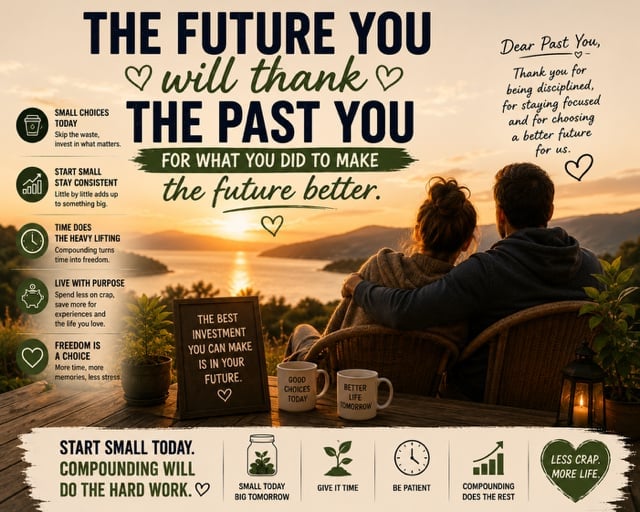
This is the single most important shift in my entire financial life, and I cannot overstate it. I stopped trying to be a person who 'remembers to save' and instead became a person who set up a system that saves for me. The automation is the engine. I have a direct debit that moves money from my current account to my Stocks and Shares ISA on the 1st of every month, and another that moves money to my easy-access savings account on the same day. I never see that money. It never lands in my current account. It doesn't feel like I'm 'saving' — it feels like I never had it in the first place. And that's exactly the point. The money you never see is the money you never spend.
If your employer offers a pension contribution matching scheme, max it out before you do anything else. That's an immediate, guaranteed, tax-free return on your money that no investment can match. It's free money, and the only thing you have to do is set it up once. Do it this week. Not next week. This week, while you're reading this and have the impulse. The impulse is the cue. Act on it now. Put the pension form in front of you, fill it out, send it. Future you will be furious at past you if you don't.
Round-up apps are another tool worth considering. Apps like Plum or Moneybox that round up your purchases to the nearest pound and invest the difference are a form of habit stacking: the spending habit (buying a coffee for £3.50) is the cue, and the saving habit (rounding up 50p) is the stacked behaviour. It's small, automatic, and you genuinely don't notice it. Over a year, those 50ps and £1.50s add up to real money. It's not a substitute for a proper savings plan, but it's a brilliant supplement — and it proves the point that automation beats willpower every time.
── The Structural Changes That Actually Move the Needle ──
I want to be honest with you about something that the 'skip the coffee' brigade won't tell you. Saving £3.50 on a coffee is good. Saving £70 on a streaming subscription is better. But the structural changes — the ones that actually move the needle — are the ones that change your housing cost, your transport cost, your grocery bill, or your tax situation. A coffee is a rounding error. Your rent or mortgage is a lever. And the most powerful lever of all is the one that automatically diverts a chunk of your income into savings before you can spend it.
The reason I'm saying this is not to discourage you from cutting the small stuff. Do that too. But don't get stuck at the level of 'if I skip one coffee a day I'll be a millionaire' — that maths is a lie, and it keeps you focused on the wrong thing. Instead, focus on the big moves: downsize your car, negotiate your rent, switch your broadband provider, check your energy tariff, move your bank account to one that pays better interest. These are one-time efforts that save you hundreds or thousands a year, every year, without you having to think about it again. They're the environmental design of your financial life. Do them once, and the savings compound.
── The Commitment Device: Making It Hard to Quit ──
A commitment device is a way of locking yourself into a behaviour by making it costly to quit. The classic example is Ulysses tying himself to the mast so he could hear the sirens' song without being lured onto the rocks. For saving money, the commitment device is simple: make it hard to get the money back out. A fixed-rate savings bond that penalises early withdrawal. A Stocks and Shares ISA where the money takes a few days to sell and transfer back to your current account. A SIPP that you can't touch until age 57. The friction of accessing the money is exactly the barrier you need to stop yourself from raiding it for a 'temporary' reason that turns out to be permanent.
I've found that the most effective commitment device is simply telling someone else. I told my wife I was going to save a certain amount each month. Not because she needed to know, but because having her know made it harder to quietly stop. Social commitment is a powerful force. You don't want to have to explain why you stopped. It's easier to just keep going. Use that. Tell a friend, a partner, a sibling. 'I'm going to save £200 a month for the next year.' The act of saying it out loud creates a contract that your future self will be reluctant to break.
── The 'Save More, Think Less' System in Practice ──
Here's what it actually looks like, day to day, in my life. Not as a prescription — just as an example of how the system works when you stop trying to be disciplined and start designing. On the 1st of every month, a direct debit moves money from my current account to my ISA. I don't see it, I don't think about it, I don't decide whether to do it this month. Past me decided. Present me just lets it happen. On the same day, another direct debit moves money to my easy-access savings account. That's the emergency fund builder, and it grows slowly, automatically, without me having to think about whether I 'should' save more this month.
I have a separate savings account at a different bank, with no card attached and no app on my phone. The money is there, but it's not visible. Out of sight, out of mind — and out of the spending path. I check my accounts once a week, on a Sunday morning, after my coffee. That's a habit stack: coffee → check balance. If I see something I don't like, I have the whole week to adjust before the next check. I don't look at it daily. Daily checking leads to daily anxiety, which leads to daily decisions, which leads to daily mistakes. Weekly is enough.
I've removed my card details from every online store I don't use at least once a month. The ones I do use once a month have the details saved, but I have a rule: anything over £50 goes in the basket and stays there for 24 hours. The 24-hour rule has saved me more money than any budget ever did. It's a commitment device built into my shopping behaviour. And I've unsubscribed from every marketing email that triggers the 'I want that' feeling. The absence of the cue means the absence of the spending loop. I don't have to resist temptation I don't see.
── What This Changes ──
The difference between the old me and the current me isn't that I'm more disciplined. It's that I've stopped trying to be. I've designed my environment so that saving is automatic and spending is deliberate. I've stacked my habits onto routines that already exist. I've removed the cues that trigger unnecessary spending. I've automated the decisions that matter. And I've made it hard to quit by wrapping the whole thing in commitment devices that my future self would have to actively undo.

The result is that I save more money with less effort than I ever did when I was 'trying hard.' Not because I'm stronger. Because I'm smarter about where I put my energy. I stopped trying to be a financial hero and started being a financial architect. I designed a system that works for the tired, distracted, 8pm-on-a-Tuesday version of me — not the aspirational, January-1st version of me. And that system has done more for my savings than ten years of guilt and New Year's resolutions ever could.
If you take one thing from this, take this: stop trying to be disciplined. Start designing. The path of least resistance will always win, so make sure the path leads where you want to go. Your future self will thank you — and they won't even have to think about it.
Invest. Wait. Repeat. Buy Less Crap. Invest Simply.