I am going to start this post with a confession that still stings a bit, even now, at 66. I didn't start properly investing until I was in my forties. Forties. Let that sink in. I had over two decades of earning, spending, and — let's be honest — frittering before I finally got my act together. Two decades of compound interest that I will never, ever get back. Two decades of time — the one thing you can't manufacture, can't buy, can't borrow — that I simply left on the table because nobody sat me down and explained how this stuff actually works.
This post is the conversation I wish someone had had with me. It's part maths lesson, part motivational speech, and part gentle (okay, not that gentle) kick up the backside. If you're 25 and reading this: brilliant, you've got a head start I'd trade a kidney for. If you're 45 and reading this: you're not too late, but stop waiting. If you're 65 and reading this: there's still time for compounding to do something meaningful — and besides, you might live to 95 and you'll want money for that. The second best time to start is right now. This is why.
── The Maths That Makes Me Want to Travel Back in Time and Shake My Younger Self ──
Let's do some numbers, because the numbers are what make this real. Imagine three people: Early Emma, who starts investing £200 a month at age 20 and keeps going until she's 60. On-Time Tom, who starts at 35 and does the same £200 a month until 65. And Late Larry — that's me, basically — who starts at 45 and throws in £400 a month (twice as much!) until 65, because he's got catching up to do.
All three earn 7% a year — roughly the long-run real return of global equities after inflation. Let's see how they do. Emma invested £200 a month for 40 years. Total contributions: £96,000. Final portfolio value: roughly £525,000. Tom invested £200 a month for 30 years. Total contributions: £72,000. Final value: roughly £245,000. Larry — bless him — threw in £400 a month for 20 years. Double the monthly contribution. Total contributions: £96,000, same as Emma. Final value: roughly £210,000. Emma has more than double what Larry has, even though they both put in the same total amount. Why? Because Emma's money had 20 extra years to compound. Twenty years of dividends reinvesting. Twenty years of growth on growth on growth. Tom started later than Emma but earlier than Larry, and his £72,000 turned into £245,000 — while Larry's £96,000 turned into £210,000. Larry put in more but ended up with less.
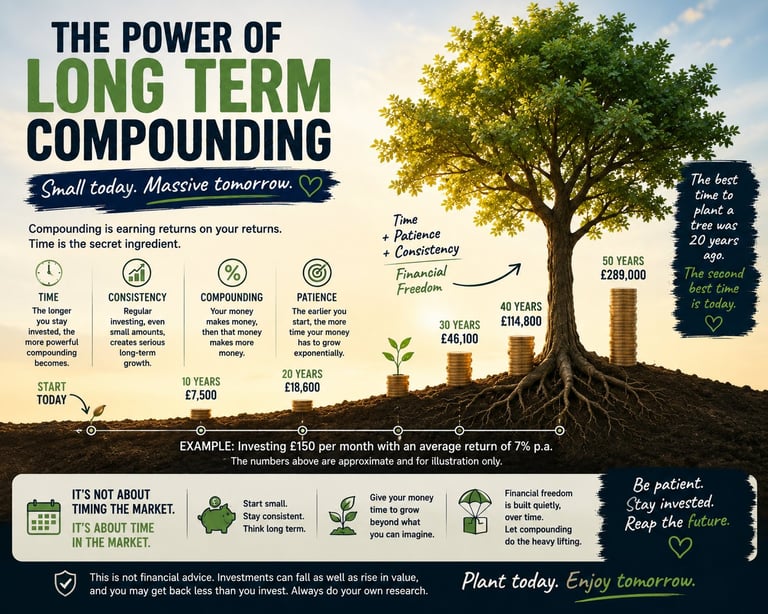
This is not a magic trick. It's not a loophole. It's the cold, beautiful, slightly brutal mathematics of compounding. The curve is exponential, not linear. The early years look flat. The middle years look respectable. The later years look like someone made a mistake on the spreadsheet. But they didn't. It's just maths. And the single biggest input — bigger than the amount you save, bigger than the fee you pay, bigger than the fund you pick — is time. Time in the market beats timing the market, yes. But time in the market also beats almost everything else. It is the closest thing to a superpower available to ordinary people with ordinary incomes.
── 'I'll Start When I Earn More' and Other Lies We Tell Ourselves ──
I've heard every version of this sentence. 'I'll start investing when I get that promotion.' 'I'll open an ISA when I've paid off the credit card.' 'I'll sort out my pension when the kids are older.' 'I'll take investing seriously when I'm earning proper money.' Each one sounds reasonable on its own. Each one is a trap. Because life doesn't pause. The credit card gets paid off and then the boiler breaks. The promotion comes and the lifestyle expands to fill the new income. The kids get older and then there's university and weddings and grandkids. There is always something. Always. The perfect moment to start investing — the moment when you have spare cash, no urgent expenses, and a clear mind free of distractions — doesn't exist. It never arrives. If you wait for it, you'll wait forever.
The solution is to start before you're ready. Start with £25 a month if that's all you've got. Start with a cheap global index fund in a Stocks and Shares ISA. Start with a workplace pension top-up. Start with literally anything that gets money into the market and compounding working in your favour. £25 a month at 7% for 30 years is about £30,000. Not a fortune, but not nothing either — and it came from £25 a month. The amount doesn't matter as much as the habit. Once the habit is established — once your identity shifts from 'person who'll invest someday' to 'person who invests' — increasing the amount is easy. It's the starting that's hard. And it's only hard because you're waiting for the perfect moment. Stop waiting. The perfect moment doesn't exist. Imperfect action beats perfect inaction every time.
── The Coffee and a Sandwich Rule ──
Here's a mental exercise I find genuinely useful. Think about something you buy regularly — a daily coffee, a meal deal, a takeaway on Friday night, a round of drinks at the pub. Not the big things. The small, routine, barely-register purchases. Now do the compounding maths on that money instead. A £3.50 coffee every working day is about £70 a month. £70 a month at 7% for 30 years: roughly £85,000. That's not 'give up coffee' advice — I'm not a monster, and besides, coffee is one of life's genuine pleasures. It's 'be aware of what you're trading' advice.
For most people, finding £100 a month to invest isn't about earning more. It's about noticing where the money is already going. The forgotten subscription (£9.99). The upgraded delivery (£3.99). The 'just one more round' at the pub (£12). The corner shop markup because the supermarket is an extra five minutes away (£4). Individually, these are nothing. Collectively, they're your future. Redirect even half of them into a cheap global index fund and let time do the rest. You won't miss the money. You genuinely won't. But you will notice the portfolio in 20 years.
── Your Biggest Advantage Isn't Your Salary ──
There's a phrase I've come to believe deeply: your biggest investing advantage isn't your income, your knowledge, or your ability to pick stocks. It's your remaining time on this planet. A 25-year-old on minimum wage who starts investing £50 a month has an advantage over a 55-year-old surgeon who starts investing £2,000 a month. The surgeon can put in more. The 25-year-old has 40 years of compounding versus the surgeon's 10. Time is the great equaliser. It's the one edge that money can't buy and nobody can take away from you. And it's the one edge that shrinks every single day you delay.
I'm not saying income doesn't matter. Of course it matters. Earning more gives you more to invest, which compounds into more wealth. But income without time is a weaker hand than you think. And time without much income — but with consistency — is a stronger hand than most people realise. The single best thing you can do for your future self is to start now. Not next month. Not when you've 'done the research.' Now. Open the account. Set up the direct debit. Buy the boring global index fund. And then — this is the hard part — do almost nothing for 20 years except keep adding more.
── Things I Wish I'd Started Earlier (A Partial List) ──
Investing in a Stocks and Shares ISA. Topping up my workplace pension. Buying VUAG every week without fail. Adding VWRP for global diversification. Automating my investments so I couldn't talk myself out of them. Ignoring the financial news. Not checking my portfolio. Compounding. Basically everything. The entire strategy. Every single piece of it.
Here's the thing: I'm 66 and I'm alright. Despite starting late. Despite making mistakes. Despite panic-selling in 2008 and buying back in too late. Despite all of it, I'm alright. Because even with a late start, even with the mistakes, even with the imperfect execution — the strategy still worked. Broadly diversified, low-cost index funds, held for a long time, added to regularly. It worked. If it worked for me — a bloke who started in his forties after decades of financial faffing about — it will work for you.
But I would have been so much better off if I'd started earlier. Not twice as well-off. Five times. Maybe ten times. The difference between starting at 20 and starting at 40 isn't double. It's an order of magnitude. That's what the maths says, and the maths doesn't care about your feelings or your excuses or your 'I'll get around to it.' The maths just sits there, cold and beautiful, waiting for you to put it to work.
── Your Future Self Is Watching ──
I'm going to end this post with something a bit different. Close your eyes — actually close them, unless you're driving, in which case please keep them open and just imagine — and picture yourself in 20 years. 20 years older. Same face, more lines. Same brain, hopefully a bit wiser. Are you glad you started investing 20 years ago? Or are you thinking 'I wish I'd started 20 years ago'? Because one of those two thoughts will be true. You get to decide which one, right now, today.
Future-you is watching present-you. They're rooting for you. They want you to open the ISA, set up the monthly debit, buy the boring index fund. They want you to skip one takeaway this month and redirect it into your future. They want you to be brave enough to start before you feel ready. Because future-you knows — in a way that present-you can only intellectually grasp — that the money you invest today is not just money. It's freedom. It's options. It's the ability to say no to a job you hate, to help your kids with a house deposit, to retire a few years earlier than you otherwise would, to sleep better at night knowing there's a cushion between you and disaster.
Future-you doesn't care whether you started with £25 or £2,500. They just care that you started. They don't care whether you picked the 'optimal' fund or the one with the lowest fee. They just care that you picked something sensible and kept adding to it. They don't care that you were scared, or uncertain, or felt like you didn't know enough. They care that you did it anyway.
The best time to start investing was 20 years ago. The second best time is today. These are not my words — they're an old Chinese proverb, apparently, though like most old Chinese proverbs it might have been invented by someone on the internet. Doesn't matter. The sentiment is correct. Time is the most powerful force in investing and you are leaking it every single day you wait.
So here's the motivational bit. The bit I wish someone had said to me 40 years ago with enough force to actually make me listen. You are not too young. You are not too poor. You are not too uninformed. You are not too late. What you are is exactly the right person, at exactly the right moment, to make one small decision that compounds into something extraordinary. Open the account. Buy the fund. Set up the direct debit. Then get on with your life and let time — beautiful, patient, inexorable time — do the heavy lifting.
Future-you is already saying thank you. You just can't hear them yet.
As always, nothing on this site is financial advice. I'm a 66-year-old UK investor sharing what I've learned — mostly the hard way. All investments carry risk, including the risk of losing money. The 7% return used in the examples is an illustrative long-run average of global equities after inflation — actual returns will be different, maybe higher, maybe lower, maybe negative for years at a time. Past performance doesn't guarantee future results. Do your own research. Speak to a qualified financial adviser if you're unsure. And never invest money you can't afford to lose. I started late and I'm alright. You can be too. Now go open that ISA.