Not financial advice. This site shares one person's personal experience with spending and investing — it is not a recommendation for you. All investing carries risk. Full disclaimer

Back to the blog

The Whole Thing

Everything I Do, In One Place

A blog about spending less. A shelf of books that has no business being on the same website. Eighty-odd articles, a handful of free calculators, and now — as of this month — a YouTube channel. People keep asking what Buy Less Crap actually is, which is fair, because the honest answer is "several things that shouldn't go together". So here it is, all of it, and where to start with any of it.

Updated 11 October 202618 min read

The Short Answer

Buy Less Crap is a UK personal finance site run by Steve, 66. It does four things: it publishes free articles about ETFs, index funds and spending less; it runs free calculators; it publishes books — seventeen of them across two author names; and it now has a YouTube channel at youtube.com/@buylesscrap. The philosophy in one line: buy one less coffee, buy less stuff you don't need, invest the difference, give it time. Nothing here is financial advice.

New

The YouTube Channel

After years of writing all of this down, I have started saying it out loud instead. The Buy Less Crap YouTube channel is live at youtube.com/@buylesscrap.

Same subject, same opinions, one fewer opportunity for me to hide behind a well-placed em dash. What I actually hold and why. Why the boring version of investing keeps winning. The things I got wrong and what they cost me. The stuff I read in the week that made me want to say something. If you've ever read something here and thought "I'd rather just watch someone explain it", this is that, and it's free — no membership, no paid tier, no channel perks.

I'll be straight about what it is and isn't. It isn't a channel where somebody stands in front of a rented car shouting about a coin. There's no thumbnail with a red arrow pointing at my own face. I don't have a system to sell, there's no link in the description to a paid group, and I'm not going to tell you that the market is about to do something only I have noticed. What it is: a 66-year-old bloke explaining, at whatever length the subject deserves, what he does with his own money and why. Some videos will be two minutes. Some will be twenty. I have no schedule and I'm not going to pretend to.

If you've been reading here for a while and have never left a comment because you'd have to type it — the channel is also the easiest way to ask me something directly. I read them. I don't always have a good answer, and when I don't I'll say so, which I've come to think is the most useful thing anyone in this space can do.

Watch on YouTube

Go on. It's cheaper than a subscription you forgot you had.

First, Who Is Doing All This

I'm Steve. I'm 66. I've spent most of my working life running businesses rather than reading about them, and I've been putting money into markets for long enough to have watched several of my own certainties turn out to be nonsense.

I am not a financial adviser. I don't have a fund, a course, a membership, a Discord, a signals group or a spreadsheet I'd like to sell you. Nobody pays me to say any of this, and if they did I'd have to tell you, which is exactly the sort of sentence that should be on more finance websites than it is.

What I have is a fairly long record of doing this in public: what I hold, what I buy, the mistakes, the things I changed my mind about, and the fairly short list of conclusions I've actually stuck to. That's the whole offering. It happens to be spread across a blog, some books, some calculators and now some videos, which makes it look like more than it is.

The reason it looks like several unrelated businesses is that it is several unrelated businesses, and I have stopped pretending otherwise.
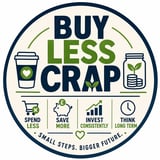
What I Actually Do

Four lines. That's the whole method, and I've never needed a fifth. Everything below this heading — every article, every book, every video — is just one of these four ideas with more words around it.

Rule 1

Buy one less coffee

This is not about cancelling your coffee, and I'd like that on the record because it's the single most misunderstood line on this website. The point isn't that coffee is bad. The point is that a habit you never consciously chose is quietly moving money out of your life every week, and you can't redirect money you never noticed leaving. So you find the one thing you'd genuinely not miss — the round you buy out of politeness, the subscription you forgot, the thing in the supermarket basket you can't remember adding — and you close that one. Not all of them. One. Then you send the difference somewhere useful. The amount is almost irrelevant; the noticing is the whole exercise, and it's the part almost everyone skips.

Rule 2

Buy less stuff you don't need

This is the one people think is about being tight, and it isn't. It's about the gap between what things cost and what they're actually worth to you. A £40 thing you use every week for six years is cheap. A £40 thing you use twice and then move around the house for a decade is expensive, and you paid for it twice — once in money, once in the annoyance of owning it. So before anything non-essential, run it past five questions: is this a need or a want; will I still be using it in a year; am I buying it to fix a feeling rather than a problem; is there a cheaper way to get the same result; and what would this exact amount be worth in thirty years if it went into an index fund instead. The honest answer to the last one ends most shopping trips. Not all of them. Most.

Rule 3

Invest the difference

Saving money in a bank account is not the same as building wealth, and confusing the two is probably the most common mistake I see. Money that sits still goes backwards — slowly, politely, but reliably. The saving only matters because of what you do with it next: cheap, global, diversified index funds, held through a tax wrapper that suits you, bought automatically on a date you don't have to remember. No picking stocks, no watching charts, no waiting for the right moment, because there is no right moment and there never was. The whole thing should take about ten minutes to set up and then require nothing from you except not touching it. If your investing requires regular decisions, it's not investing, it's a hobby — and hobbies cost money.

Rule 4

Give it time

This is the part nobody can sell you, which is precisely why you hear so little about it. You can buy a fund, you can buy a course, you can buy a subscription to somebody's research — but you cannot buy the one ingredient that does most of the work. Time just has to pass, and it passes at the same speed whether you're checking your portfolio daily or not at all. That's genuinely annoying, and I've found no way around it. What it does mean is that the most powerful thing a person can do is start, even badly, even small, even with money they'll later laugh at. The second most powerful thing is to keep going. Everything else is decoration on top of those two.

Invest. Wait. Repeat.

The three-word version. It has never needed updating, which is the entire point. If a method needs revising every time the market gets exciting, it wasn't a method.

I should be honest about the trade-off, because there is one. This approach is not going to make anyone rich quickly. It has no edge, no secret, no angle, and nothing in it that couldn't be explained to a reasonably bright fourteen-year-old in about ten minutes. That is not a flaw in the method — that is the method working as designed. The complicated version of investing exists to sell things to you.

What it does have is a very high chance of surviving contact with real life, which is where most investing plans actually die. People don't fail at this because they picked the wrong fund. They fail because they got bored, or scared, or they wanted the money, or they read something on a Sunday and did something on a Monday.

So the plan is deliberately dull enough that I keep doing it when I don't feel like it. That's the entire trick, and I've never found a better one.

What's On The Site

Three things, plus the video. All of it free, none of it behind an email address.

Books

Fourteen books out, more in production. No plan.

A comedy survival guide to modern life. A midlife audit. A dystopian thriller. A cookbook for a mushroom nobody had heard of five years ago. A book about beans, which somehow has 69 chapters. And seven comedy books about a King, a Donkey and a goat called Keith.

The blog

Eighty-odd articles and not one of them a sales pitch

What I actually buy and why. The mistakes I've made with real money. ETF comparisons in plain English. Why I stopped watching financial news. What compound interest really does over forty years. No email wall, no funnel, no upsell at the bottom.

There are around eighty articles here now, and I've never deleted one for being wrong — I've gone back and added a note at the top instead, because the wrong ones are more useful than the right ones. You'll find ETF comparisons written for people who don't want to learn what a UCITS is; honest accounts of things I got wrong and roughly what they cost me; arguments with myself about cash ISAs, financial news, and whether any of this is worth the bother; and the occasional piece that's really about happiness wearing a frugality costume. Nothing is behind an email address. There's no sequence you have to follow, no funnel, and nothing at the bottom of an article trying to sell you the next thing. It's a blog, in the older sense of the word.

Free tools

Calculators that tell you the truth, including the boring bits

Compound interest, budget, and the coffee calculator — the last one exists purely to settle an argument. They run in your browser, they don't ask for your email, and they don't flatter the numbers.

Three calculators, and they exist because I got tired of explaining the same arithmetic in comments. The compound interest one shows what a monthly amount actually becomes over a realistic number of years, at rates you can change, including the bit people find hardest to believe — that the person who invests for ten years and then stops can end up ahead of the person who starts later and invests for thirty. The budget one is the least glamorous page on this website and probably the most useful. The coffee calculator exists to settle one specific argument, repeatedly, and I have no regrets about it. All three run entirely in your browser, ask for nothing, store nothing, and won't let you enter a rate that flatters the answer.

The Numbers, Since Somebody Will Ask

1

YouTube channel

New — @buylesscrap

14

Books published

More in production

80+

Blog articles

Free, no email wall

66

Years old

Started late, on purpose

No Lamborghinis, no rented mansions, no promise of overnight riches. Just those numbers.

And Then There Are The Books

Seventeen of them, and I still can't explain how that happened. If you only read one page about them, read the catalogue:

The short version: S.R. writes the humour and the non-fiction — a survival guide to modern life, a midlife audit, a dystopian thriller, a bean book with sixty-nine chapters, and a lion's mane mushroom cookbook. W. Ingle writes the seven comedy Wingle Universe comedy books, about a King who isn't qualified, a Donkey who quietly is, and a goat called Keith who has eaten Chapter 23. Not the manuscript. The actual chapter.

See All 14 Books →

Every cover, every blurb, every buy link — on one page.

Where To Start

Four doors. Pick the one that matches the mood you're in.

If you want to watch rather than read

The YouTube channel. Same opinions, spoken aloud, in whatever length suits the subject.

If you're new to investing

Start Here — the entry point, in the right order, with nothing assumed.

If you want to know what I actually hold

My portfolio and my investment strategy. Deliberately boring. That's the feature.

If you came for the funny books

Start with I'm The King. Don't Ask Why. — Book 1 of the Wingle Universe, and the only series on this site involving a red button.

What I Don't Do

This list is longer than the one above it, and it's the more useful of the two.

I don't give financial advice

This is the important one. I describe what I do with my own money. I don't know your circumstances, your debts, your age, your income, your tolerance for losing 30% and staying calm, or what you're actually saving for. Anyone who tells you what to do with your money without asking any of that is guessing, and you're paying for the guess.

I don't sell a course, a membership or a community

There's no paid tier, no private group, no monthly subscription to my thoughts, no 'inner circle'. The articles are free, the calculators are free, the videos are free, and the newsletter is free and doesn't try to funnel you into anything.

I don't run a signals group or tip shares

I don't tell anyone what to buy on Monday. Not in a group, not in a DM, not in a video. If somebody is ever offering you that under my name, it isn't me.

I don't take affiliate money to recommend funds

I mention the platforms I actually use — Trading 212, InvestEngine, Vanguard — because those are the ones I use. If a page ever earns money from a link, it says so plainly on the page rather than in a footnote nobody reads.

I don't do 'get rich quick', and I don't do Lamborghinis

No rented mansion videos, no fake lifestyle, no implication that any of this leads to a car with scissor doors. The honest return on doing this properly is that one day you notice you're not worried about money any more, which makes a terrible thumbnail and a very good life.

I don't claim to be an expert

I'm not a financial adviser and I've never pretended to be one. I'm 66, I've invested for a long time, and I write down what I do and what I get wrong. That's the whole qualification, and I'd rather be honest about its limits than inflate it.

I realise a list of things somebody doesn't do is an odd thing to publish. But if you've spent any time looking for financial information online, you'll know why it's here: almost everything you find is attached to something. This isn't. That's the entire difference, and it isn't a clever one — it just happens to be rarer than it should be.

What's Coming

Honestly: whatever I feel like on the day. But here's what's actually in motion.

More video. The channel is the newest thing here and the one I'm putting the most into at the moment. The written version of all of it already exists — the videos are about making it easier to start, not about replacing what's already written down.

More books, unfortunately. There are seventeen. I had no plan to write any of them. Every time I think I've stopped, another one turns up — including one I forgot I'd written and then had to write a whole article apologising for forgetting. I'd like to say I've stopped. I've said that before, and it has never once been true.

More articles in the same shape. Plain English, no hype, written by somebody telling you what he does rather than what you should do. If a subject has been covered to death elsewhere in a way that made it more confusing rather than less, that's usually a sign I'll have a go at it here.

And a few things I haven't thought of yet, which is how most of this got started. The blog began as a way of writing down what I was doing with my own money. The books began as a joke. The channel began because enough people asked. I've stopped making plans for this website, because the website has never once followed one.

Questions People Actually Ask

What does Buy Less Crap actually do?+

Buy Less Crap is a personal finance website run by Steve, a 66-year-old UK business owner and investor. It covers four things: spending less on things you don't need, investing the difference simply and cheaply (ETFs and index funds through platforms like Trading 212, InvestEngine and Vanguard), publishing books, and — as of 2026 — a YouTube channel at youtube.com/@buylesscrap. It is a personal blog, not a regulated advice service.

Does Buy Less Crap have a YouTube channel?+

Yes. The Buy Less Crap YouTube channel is at https://www.youtube.com/@buylesscrap. It is the newest part of the site and covers the same ground as the blog — simple investing, buying less rubbish, and the occasional bit of nonsense — in video form. It is free to subscribe and there is no paid tier.

How many books has Buy Less Crap published?+

Seventeen, across two author names and several very different shelves. S.R. writes humour and non-fiction including Am I Ready For This Shit?, the Mid F@@K Life Crisis midlife audit, What's The Point When There Is No Point?, The World's Most Boring Book About Beans (Recipes, Facts & Other Things You Never Thought You'd Need to Know), Genesis of Rebellion (a dystopian thriller) and The Power of Lion's Mane Mushroom. W. Ingle writes the seven comedy books of the Wingle Universe, starting with I'm The King. Don't Ask Why. There is a complete list at buylesscrap.co.uk/blog/every-book-on-buy-less-crap.

What is the Buy Less Crap investing philosophy?+

Four rules: buy one less coffee, buy less stuff you don't need, invest the difference, and give it time. In practice that means spending less than you earn, keeping a cash buffer, taking every penny of employer pension match, holding cheap global index funds for decades, and not fiddling with any of it. The point isn't frugality for its own sake — it's that spending less automatically buys you more time, and time is the only ingredient in investing that can't be bought.

Is Buy Less Crap financial advice?+

No. Nothing on Buy Less Crap is financial advice. It is one person's record of what he does with his own money, published so other people can compare notes. All investments can go down as well as up. Always do your own research and seek professional advice where appropriate.

Where should I start on Buy Less Crap?+

If you want the investing basics, start with the Start Here page or Getting Started. If you like reading in order, the blog archives are free and unfiltered. If you prefer watching, the YouTube channel at youtube.com/@buylesscrap covers the same ground. If you came for the comedy books, start with I'm The King. Don't Ask Why.

Do I need to give my email address to use Buy Less Crap?+

No. Every article, calculator and book page on Buy Less Crap is open — there is no email wall, no paywall and no gated download. There is an optional newsletter if you want new posts by email, and that is the only thing on the site that asks for anything.

Who is Steve from Buy Less Crap?+

Steve, a 66-year-old UK business owner and investor. He writes about ETFs, index funds and spending less, holds a deliberately simple portfolio through platforms such as Trading 212, InvestEngine and Vanguard, and admits freely that he is not a financial expert — just somebody sharing what he does, what he gets wrong, and what he has learned.

Nothing on this page — or anywhere on Buy Less Crap — is financial advice. All investments can go down as well as up. I'm not a financial expert; I'm a bloke sharing what he does with his own money. Do your own research and seek professional advice where appropriate.